One Sunrise Saison wort, two wheat yeasts — a three-point decision
SafAle BW-20 edged LalBrew Wit Belgian by three points in the first Saison Yeast Trial: 55 to 52. Both finished at 1.002, and neither gave me the full citrus, tropical fruit, and Saison yeast character I was chasing. BW-20 advances, and I preferred it in both tastings. This is the first pairing in the Wheat & Phenolic category, using Sunrise Saison V1 as the shared wort. The scores came from the second tasting, when I knew which was which; the first was blind and unscored.
The verdict
| Yeast | SafAle BW-20 | LalBrew Wit Belgian |
|---|---|---|
| Score | 55/100 | 52/100 |
| OG → FG | 1.045 → 1.002 | 1.045 → 1.002 |
| Apparent attenuation | 95.6% | 95.6% |
| Appearance | Yellow, white head, clearer | Yellow, white head, hazier |
| Result | Advances to the category final | Eliminated from the Saison Yeast Trials |
Scores are from my one identified, scored tasting; the earlier blind tasting was unscored.
OG is the gravity reading before fermentation, FG the reading after. Apparent attenuation is how completely the yeast fermented the sugars, worked out from those two readings — 95.6% is very dry.
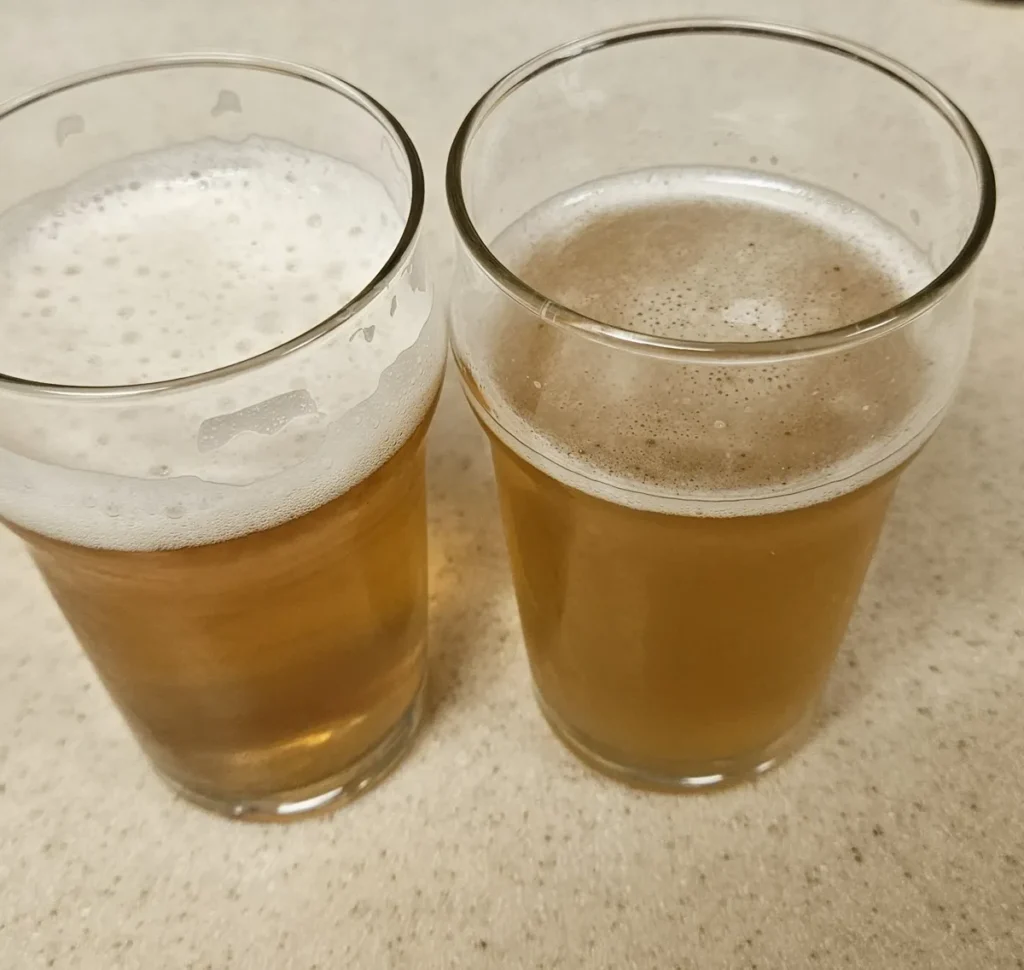
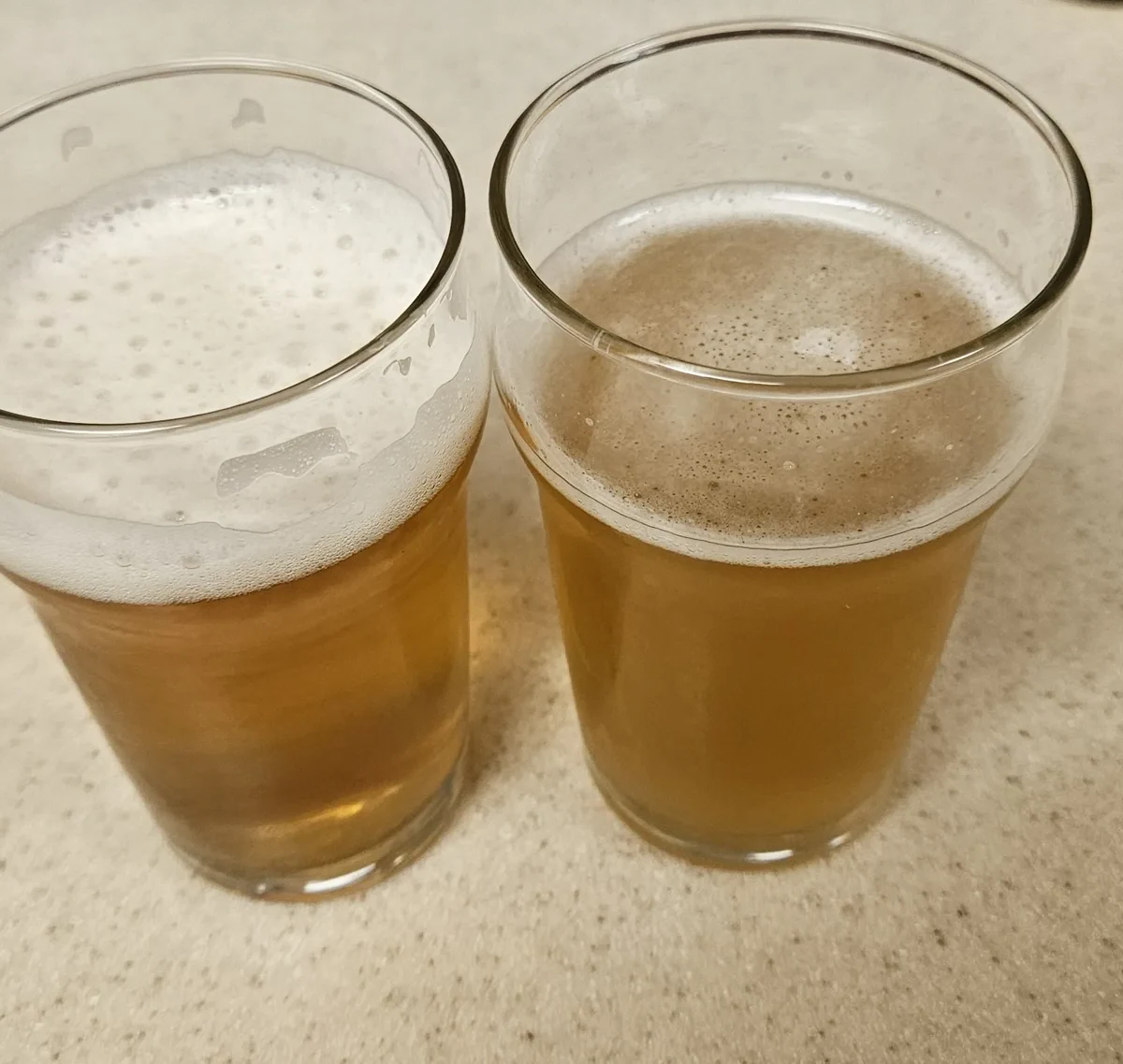
The finished beers in matching glasses: BW-20 on the left, clearer; Wit Belgian on the right, hazier. Both poured with a white head.
What beer was I trying to brew?
I wanted definite citrus, more tropical fruit, and the spicy, phenolic (peppery, clove-like) character I associate with Saison yeast. The spices were especially important to the direction I had in mind.
The recipe behind it, in general terms: a pilsner, two-row, and white wheat base with smaller amounts of Munich and amber malt, flaked oats, and dextrose to keep it dry. Magnum for bittering, Saaz late, then a Pacific Jade, Sorachi Ace, and Wakatu hop stand, with coriander seed and orange peel at flameout. The full recipe is at the end of this post.
I had brewed with LalBrew Wit Belgian before. BW-20 was new to me, which made it interesting to try. I saw them as two similar wheat-oriented options, so pairing them felt like a useful comparison. I expected some spice and pepper, and I was surprised that Wit did not bring more citrus to the finished beer.
The audience voted this pairing first on Instagram; the vote decided the order of the trials.
How was the trial run?
This was brewed on 27 July 2026 and carried past midnight into the 28th — one wort, split between two iGulu S1 fermenters at about 4 L (1.06 gal) each.
I brewed on my small stovetop setup, heating water in a roughly 19 L (5 gal) stainless steel pot and mashing in a small cooler. Preheating the cooler helped: I put a smaller amount of hot water in it while the strike water finished heating, which reduced the temperature drop when the strike water went in.
The awkward part was grain handling. For this batch the grain went loose into the cooler, and afterwards I dumped the whole mash into a bag to filter out the grains. It worked, but it was clumsy. On Trial #2 I put the bag in the cooler from the start, and that worked much better.
I used an auto-siphon to transfer the wort from the pot, filling the two fermentation vessels to matching levels. Each received 2.75 g (about 1/4 of a packet) of weighed dry yeast, pitched directly at 20 °C (68 °F).
Both iGulu units were set to the same temperature program. The recorded profile started at 20 °C (68 °F), rose toward 22 to 23 °C (72 to 73 °F), and held before a later cold crash. I selected the lowest fermentation-pressure setting available, which I remember as roughly 2 to 3 psi. That pressure is a recollection rather than a precise logged value.
What did fermentation show?
BW-20 showed visible activity by 16 hours after pitching. At 20 hours, its krausen — the foam on top of the fermenting beer — was at least about 2.5 cm (1 in) high. Wit had no visible activity in those early notes. By 40 hours, I could see activity in Wit, although it had not formed a krausen yet.
At about 58 hours, BW-20 had reached the gas-release connection and fallen back, while Wit was forming a thin layer of foam. The BW-20 foam interrupted operation and needed attention. I fitted a sanitized spare lid, reconnected the unit, and cleaned the original lid. The swap took at most about a minute; I left the fermentation program running throughout.
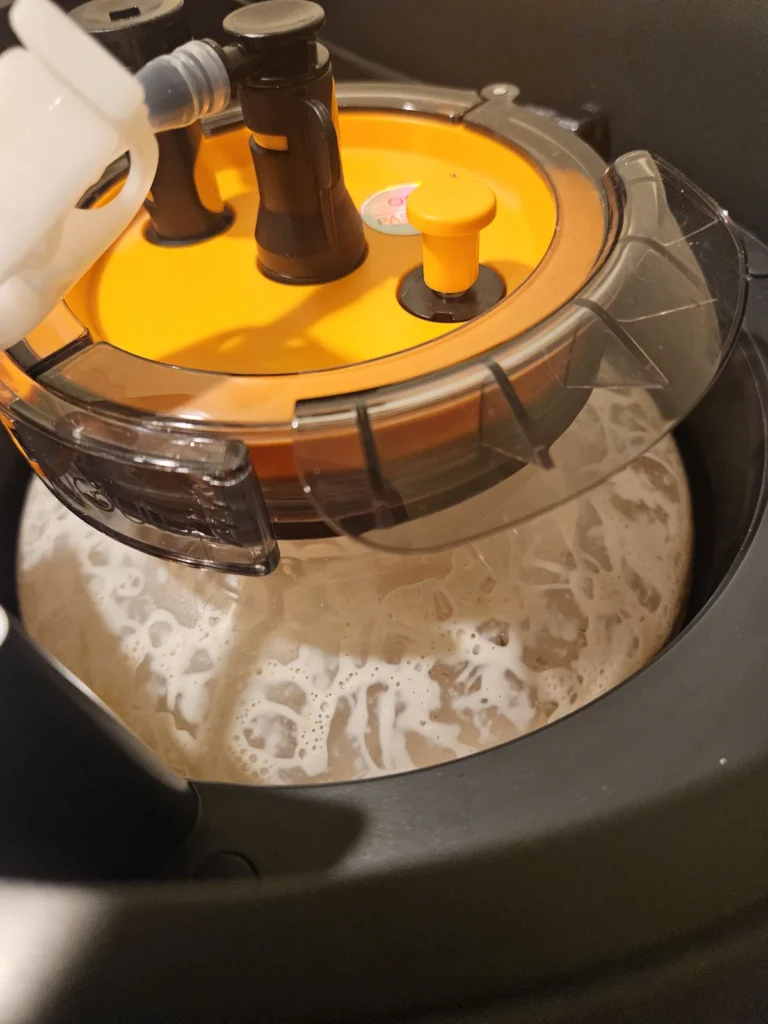
SafAle BW-20 at approximately 58 hours after pitching: foam residue high inside the vessel.
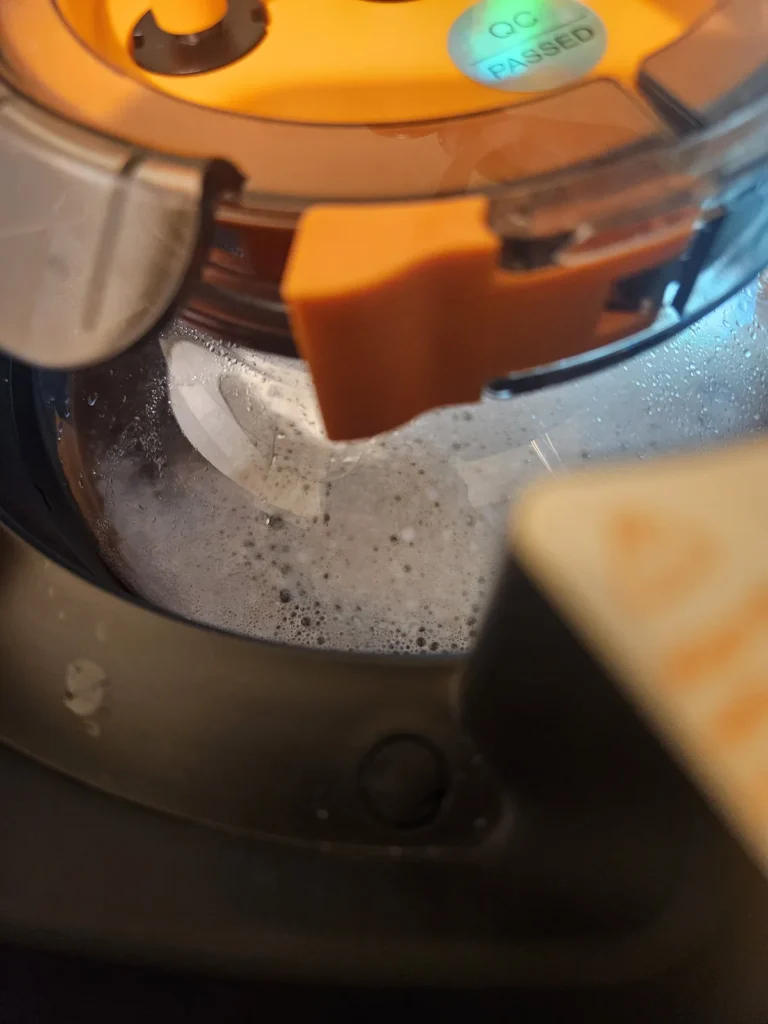
LalBrew Wit Belgian at approximately 58 hours after pitching: a thin layer of foam on the beer.
The photos document visible foam, not gravity or fermentation completion.
That extra handling on the BW-20 side belongs in the comparison. The shared program was the plan, but one vessel needed an intervention. The visible activity also does not tell me exactly when either beer began or completed fermentation. I did not have a continuous gravity trace.
I measured the final gravity with a hydrometer. Both beers were recorded at 1.002, so the endpoint reading did not separate them despite the very different early foam activity.
How did I taste them?
The beers never left their fermentation vessels — conditioning, carbonation, and serving all happened in the iGulu units. For carbonation, I connected CO2, set it to 15 psi, and left it there. I was aiming for about 2.7 volumes of CO2; at 3 to 4 °C (37 to 39 °F), 15 psi works out to roughly 2.8 to 2.9 volumes once the beer reaches equilibrium, so it likely finished a touch more carbonated than the target.
I was the only taster in both sessions. The first tasting was blind and unscored. About ten days later, I tasted again knowing which yeast was in each glass and scored both beers in that one session. The 55 and 52 totals come from that later, identified tasting, held in early September — roughly six weeks after brew day.
I used matching glassware and similar pour sizes, with the beers at the same temperature and carbonation conditions. My slight preference for BW-20 stayed consistent across the two sessions. There are no numerical scores from the initial blind tasting to compare with the later totals.
I also tasted Sango Saison as an informal reference for the general Saison direction. Even that beer was less fruity and less expressive in Saison character than my ideal. It was a reference, rather than a third entry in this scored trial.
Where did the three points come from?
| Category | Available | BW-20 | Wit Belgian |
|---|---|---|---|
| Aroma | 20 | 12 | 11 |
| Flavor | 30 | 18 | 16 |
| Mouthfeel and finish | 15 | 9 | 9 |
| Recipe fit | 25 | 10 | 10 |
| Overall impression | 10 | 6 | 6 |
| Total | 100 | 55 | 52 |
The entire gap came from aroma and flavor. BW-20 had a little more citrus, especially in the aroma, although the citrus was still light. That earned it one extra aroma point. There may also have been a slightly smoother overall flavor impression, though that difference was subtle and harder for me to name. BW-20 received two more flavor points.
Both beers were yellow with a white head. BW-20 was clearer and Wit Belgian was hazier. Their flavor profiles were close, with light citrus, spice, and pepper. I described both as lively, refreshing, and light in mouthfeel, and gave them the same mouthfeel-and-finish score.
A three-point lead was enough for me to advance BW-20 because it matched my preference in both tastings. This is one brewer’s decision from one batch and one scored session. I would not use it to rank these yeasts universally.
Why did recipe fit stay low?
Both beers scored 10 out of 25 for recipe fit. I wanted more of the spicy, phenolic impression I associate with Saison yeast, alongside the spices I had added. I also wanted more tropical fruit and a stronger citrus aroma. Neither version really reached that picture.
Choosing Wit because it was Belgian had made sense to me when I was thinking about a Belgian Saison direction. Tasting the result made me think harder about the specific strain and what I wanted it to contribute. The yeast was the deliberate change; the wort was the same. The handling wasn’t quite identical — BW-20’s lid swap saw to that.
I could still see myself building a recipe around a wheat or Wit strain. That would mean thinking about the beer that works with that yeast, rather than expecting this recipe to produce the same character with every strain. If I want to know what a different fermentation temperature does, that would need its own comparison.
Would I brew it again?
Not this beer as it stands. It wasn’t bad, but it wasn’t amazing either, and I expect there are better yeasts for this recipe still ahead in the trials. That’s the point of running the comparisons instead of guessing.
I would use BW-20 again — in a wheat-style beer built for it, where its spice, pepper, and light citrus lead the beer instead of playing support for a Saison character it only partly delivered.
What happens to the loser?
Wit Belgian is eliminated from the Saison Yeast Trials. That’s the format: lose your pairing and you leave the series. It could still come back in a different experiment one day — just not in this one.
What happens next?
This trial belongs to Wheat & Phenolic, the current category, which has three paired comparisons. Trial #2, SafAle W-68 versus LalBrew Munich Classic, has been brewed and tasted; its post follows this one. The third pairing is SafAle WB-06 versus SafAle T-58. I am keeping the same Sunrise Saison recipe across these three wheat-category trials.
After those comparisons, I plan to develop a new recipe tailored more closely to the wheat strains. The current plan is a purpose-built Yuzu Saison. I will brew one wort, split it three ways, and pitch the three trial winners separately to choose the wheat-category winner on that new recipe. BW-20 goes through to that final.
I will probably revise Sunrise Saison for the next yeast category, which is likely to be Saison & Farmhouse. Each category will work toward a winner before I move on. Once all the category winners are selected, I plan to compare them across categories.
For future tastings, I want to keep the same sequence: a blind, unscored tasting first, followed about ten days later by an identified tasting with scores. That gives me an initial preference to return to when I sit down with the score sheets again.
BW-20 took this one 55–52. Have you brewed with either strain? What citrus or spice character did you get, and at what temperature? Comments are open below.
Follow the trials as they happen on Instagram @alechemylab. New to the Lab? The Saison Yeast Trials overview explains the whole series — and the rest of the trials live in the Yeast Trials archive.
Which yeast won Trial #1, and by how much?
SafAle BW-20 won Trial #1, 55–52 over LalBrew Wit Belgian, in my single identified scored tasting. Both used the same Sunrise Saison V1 wort. The three-point gap came from aroma (12–11) and flavor (18–16); the other categories tied. Both finished at 1.002. BW-20 advances; Wit Belgian is eliminated.
What was different between the two beers?
The beers were similar: SafAle BW-20 had slightly more citrus aroma and possibly a slightly smoother flavor; LalBrew Wit Belgian was hazier. BW-20 showed visible activity by 16 hours, compared with Wit by 40 hours. At about 58 hours, BW-20 had high foam residue, while Wit had developed a thin foam layer.
Would you brew with BW-20 again?
Yes — but not in Sunrise Saison V1. I would use BW-20 again in a wheat-style beer built for it, where its spice, pepper, and light citrus lead instead of supporting a Saison character it only partly delivered. I would not brew Sunrise Saison V1 again as it stands: it was not bad, but it was not amazing either.
What stayed the same in the method?
Sunrise Saison V1 wort, yeast dose, and temperature program were matched. Each iGulu S1 received about 4 L (1.06 US gal) and 2.75 g (about 1/4 packet) of dry yeast at 20 °C (68 °F). The yeast was the change I made on purpose, but BW-20 needed a lid swap, so the handling wasn’t identical. Both used 15 psi carbonation.
What would I need for a similar trial?
Split Sunrise Saison V1 into about 4 L (1.06 US gal) per fermenter, with 2.75 g (about 1/4 packet) each of SafAle BW-20 and LalBrew Wit Belgian. Use the temperature outline; exact ramp and hold timings are not supplied. Use pressure-rated equipment for carbonation. Taste blind and unscored first, then score identified about ten days later with the published rubric.
Appendix: the original recipe — Sunrise Saison V1
This is the original Sunrise Saison V1 used for Trial #1. A note on versions: the recipe stays V1 across yeast changes — the version only changes when I change the recipe itself, so later trials on this same recipe are still V1 even with different yeast pitched.
- Brewed: 27 July 2026
- Target volume: 8 L (2.1 gal). Brewfather records 8.25 L (2.18 gal) into fermentation in total; my split was about 4 L (1.06 gal) per vessel
- OG / FG: 1.045 / 1.002 (both beers)
- Calculated ABV: 5.6%
- Apparent attenuation: 95.6% (both beers)
- Estimates: 27 IBU, 5 SRM
- Mash: 65 °C (149 °F) for 60 minutes, then 77 °C (171 °F) for 10 minutes
- Boil: 60 minutes
- Yeast: SafAle BW-20 in one half and LalBrew Wit Belgian in the other; each received 2.75 g (about 1/4 of a packet) of weighed dry yeast, pitched directly into about 4 L (1.06 gal) of wort.
- Fermentation: both iGulu S1s started at 20 °C (68 °F), rose toward 22 to 23 °C (72 to 73 °F), and held before a later cold crash. Fermentation pressure was recalled as roughly 2 to 3 psi. BW-20 required the sanitized lid swap described above.
- Conditioning and carbonation: the beers stayed in their fermentation vessels. CO2 was set to 15 psi at 3 to 4 °C (37 to 39 °F). The target was 2.7 volumes; the equilibrium estimate was roughly 2.8 to 2.9 volumes, rather than a measured carbonation value.
| Fermentable | Amount |
|---|---|
| Pilsner malt | 585 g (20.6 oz) |
| Premium 2-row malt | 293 g (10.3 oz) |
| White wheat malt | 210 g (7.4 oz) |
| Dextrose | 190 g (6.7 oz) |
| Munich I malt | 133 g (4.7 oz) |
| Amber malt | 87 g (3.1 oz) |
| Flaked oats | 59 g (2.1 oz) |
| Hop | Amount | Addition |
|---|---|---|
| Magnum | 4 g (0.14 oz) | 60 minutes before end of boil |
| Saaz | 6 g (0.21 oz) | 10 minutes before end of boil |
| Pacific Jade, Sorachi Ace, Wakatu | 4 g (0.14 oz) each | 15-minute hop stand at 76.7 °C (170 °F) |
At flameout: 2 g (0.07 oz) coriander seed, 3 g (0.11 oz) bitter orange peel, and 4 g (0.14 oz) sweet orange peel.