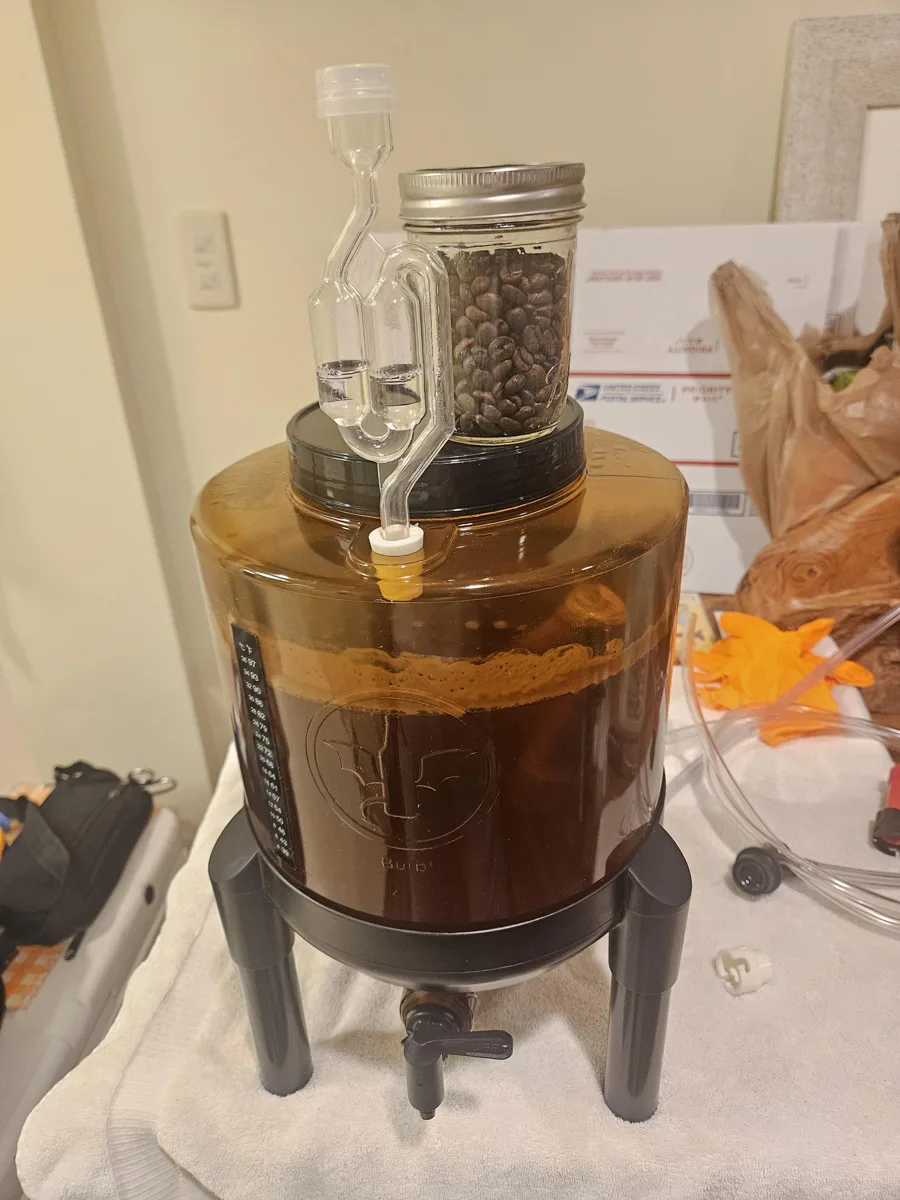
A friend asked for a coffee blonde. I’d never brewed one — so I built one.
The beans went in unsanitized, and the transfer waited on an empty CO₂ tank.
The verdict
| Gilded Roast V1 | |
|---|---|
| My score | 3.6 / 5 |
| Style | Blonde ale with coffee |
| OG → FG | 1.046 → 1.009 |
| ABV / IBU / SRM | 4.9% calculated / 19 estimated / 4 estimated |
| Coffee | 56 g (2 oz) whole Kaldi Brazil beans in 8.7 L (2.3 US gal); about 6.4 g/L (24 g per US gallon), 72 hours; fridge set to 3.3 °C (38 °F) |
| Carbonation | 10–11 psi at 3.3 °C (38 °F); approximately 2.4 volumes estimated |
Gilded Roast is a 4.9% blonde ale finished with 56 g (2 oz) of whole coffee beans in 8.7 L (2.3 US gal) of beer, transferred off the beans after 72 hours — I scored it 3.6 out of 5. The result is a clear golden blonde with a coffee aroma that outshines everything else in the glass; coffee leads the flavor too, backed by a little chocolate and caramel-toffee, and the weak point is the head: there isn’t much of one.
(OG and FG are the gravity readings before and after fermentation — shorthand for how much sugar was in the wort and how much was left at the end. In a hurry? Jump to the full recipe at the end.)
Why brew a coffee blonde?
Most coffee beers are stouts and porters, where the roasted malt and the coffee pull in the same direction and cover for each other. A blonde has nowhere to hide: a light, clean base beer, and coffee sitting right on top of it. That’s the version of the problem a friend put in front of me when he said he wanted a coffee blonde — and since I’d never brewed one, I did some research and developed the recipe myself.
The name is the beer in two words. Gilded is the golden blonde underneath; Roast is the coffee on top.
For the beans, I didn’t go shopping for anything exotic. I used Kaldi Brazil beans — the coffee I regularly drink myself, which I buy locally.
What did I brew?
The full recipe card is at the end of this post. In general terms: a simple blonde ale built on premium two-row with a small amount of caramel 10L malt for a touch of color and sweetness, a single Magnum bittering addition at the start of the boil, and distilled water built up to a soft blonde profile. I fermented it with White Labs California Ale Dry (WLP001), a clean yeast that stays out of the way.
How did brew day go?
This was brewed on 28 September 2026 on my small-batch stovetop setup. The grain mashed at 67 °C (153 °F) for 60 minutes in a cooler with a bag inside it — the bag holds the grain so I can lift it out and sparge (rinse the grain with hot water to wash out the remaining sugars). It’s the arrangement I’ve settled on for these batches; my first yeast trial mashed loose in the cooler and filtered afterwards, which was clumsy by comparison. After a 60-minute boil with the one hop addition at the start, I chilled the wort and pitched the yeast. From a planned 9.5 L (2.5 US gal) batch, 9.28 L (2.45 US gal) went into the fermenter, a BrewDemon (a small conical fermenter — the foil-wrapped vessel in the transfer photos).
Fermentation ran at 18.9 °C (66 °F), ramping to 20.5 °C (69 °F). By the time the beer was ready to move, the gravity had settled at 1.009 and was holding there — that’s how I knew it was finished.
How much coffee do you add to beer?
For this batch: 56 g (2 oz) of whole beans in about 8.7 L (2.3 US gal) of beer — roughly 6.4 g/L (24 g per US gallon) — steeped for 72 hours at fridge temperature.
I put whole, uncrushed beans into a keg and transferred the finished beer onto them. The plan was to begin tasting at 24 hours and transfer the beer off the beans when the flavor caught up to the aroma. I expected that to take around 36–48 hours, with about 72 hours as the outer limit.
Whole beans suited that plan: I could taste daily, then move the beer into another keg and leave the beans behind. I wanted a clear coffee character without an acrid edge. The daily tastings, rather than a fixed extraction time alone, would tell me when it was ready.
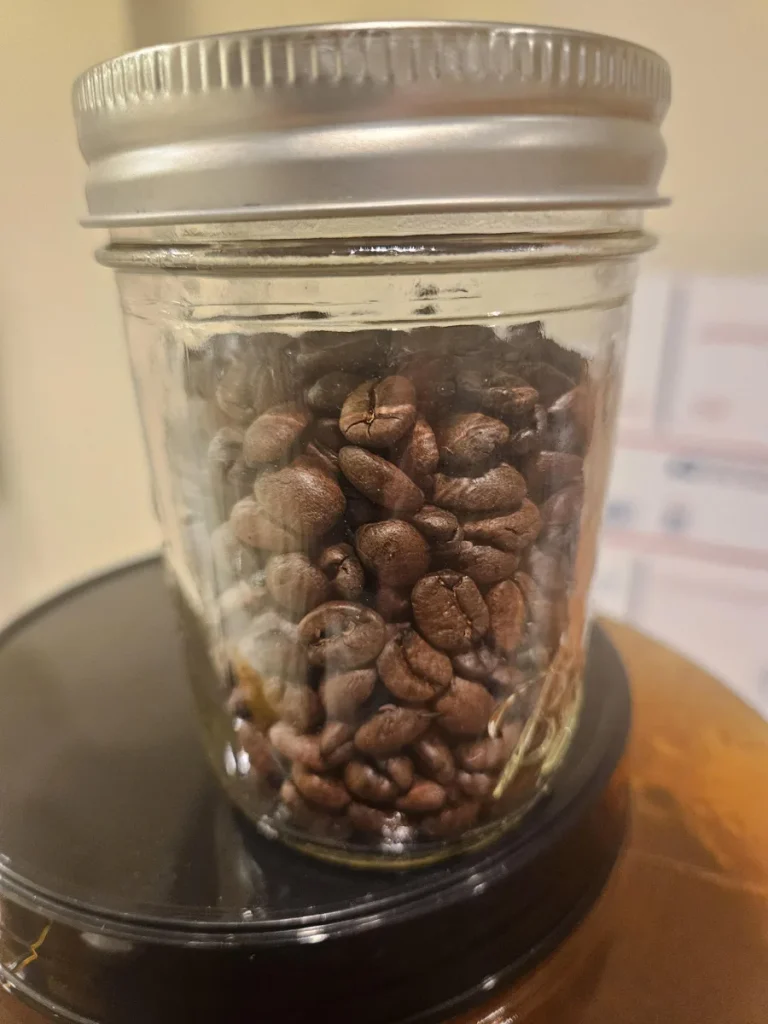
some always stays behind with the sediment. If you’re scaling this, dose against the beer in the keg, not the batch size on paper.
The transfer that had to wait
The plan was to transfer the finished beer onto the beans around 11 October. My CO₂ tank had other ideas — it was empty, and getting a replacement CO₂ supply had just become slower and more expensive than it used to be. I wanted CO₂ available to purge the receiving keg before transferring the beer, so the beer waited in the fermentation chamber until a tank arrived, and the transfer happened on the evening of 14 October.
One thing worth stating plainly, because it would be easy to assume otherwise: the beer was not cold crashing during that wait. It sat at fermentation temperature in the chamber. The cold crash — holding the beer cold so sediment drops out and it clears — came later, in the conditioning keg, with the beer already on the beans.
How did I add the coffee?
I didn’t sanitize the beans — they went into the conditioning keg whole, straight from the bag. I was counting on the alcohol in the finished beer. Whether that’s actually enough, I haven’t tested. This batch, at least, showed no sign of infection through the 1 November verdict tasting.
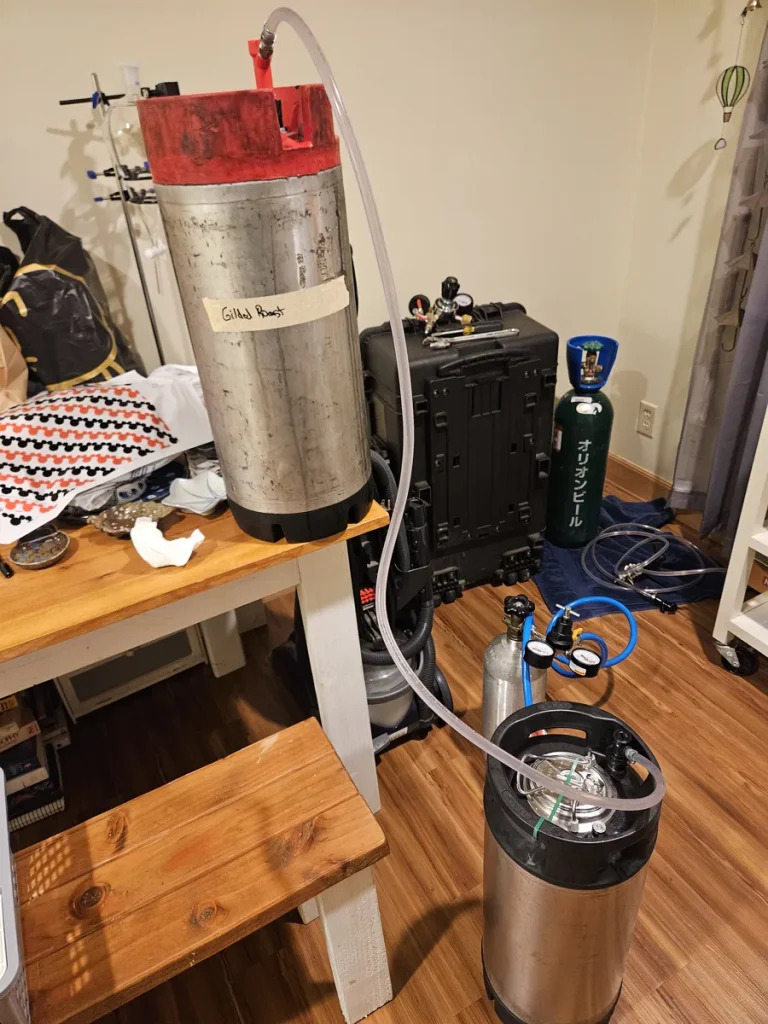
I purged the conditioning keg with CO₂ first, then ran a line from the fermenter’s spout to the keg’s liquid post. The beer filled the keg from the bottom up through its floating dip tube, lid closed, and I vented the keg’s gas a little at a time as the beer came in to make room for it. It wasn’t a true closed transfer: there’s no gas line running back to the fermenter, so the keg side stayed closed and purged, but the fermenter side breathed — as the beer drained out, air was drawn in to replace it.
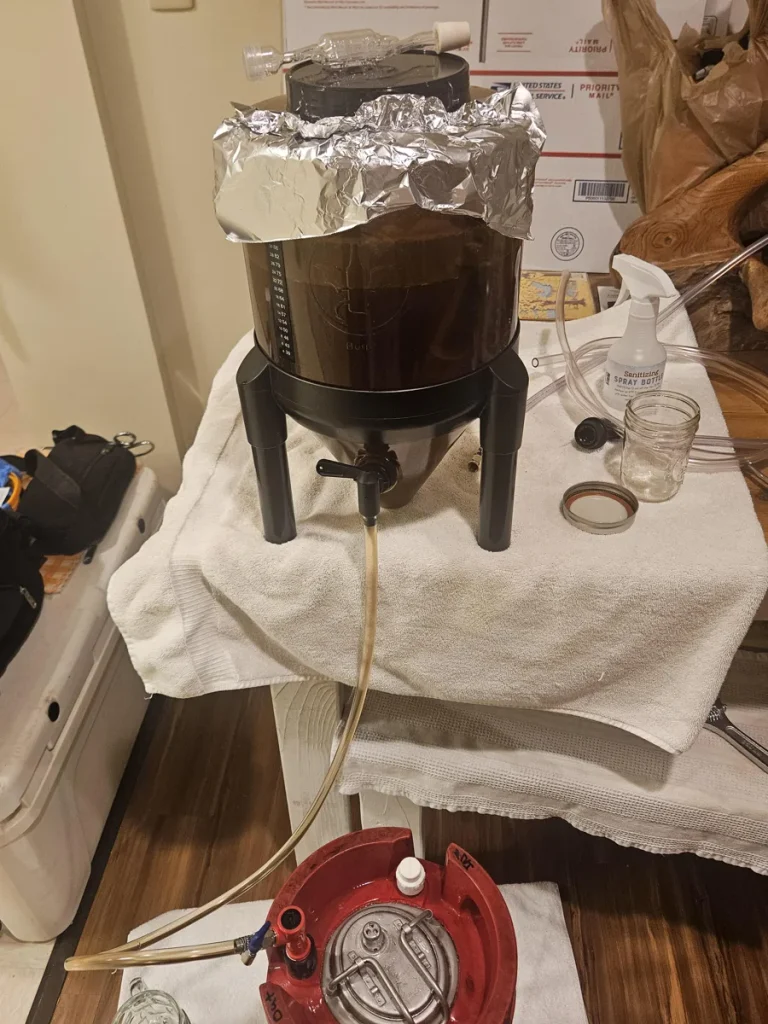
went into the fridge set to 3.3 °C (38 °F), so the cold crash and coffee extraction happened together as the beer cooled.
How long do you leave whole coffee beans in beer?
The beer went onto the beans on 14 October and came off on 17 October, tasted daily:
Day 1 (24 hours): The aroma was already there — heavy coffee, like smelling the beans themselves, with a slight vanilla and roast note. The flavor lagged behind: light coffee, a touch of chocolate, a slight berry note, and an almost spicy edge. Good, but not enough yet.
Day 2 (48 hours): The same profile, building. The flavor was closing on the aroma but hadn’t caught it.
Day 3 (72 hours): The flavor matched the aroma. That’s the target I’d set before the beans went in — when the taste catches the smell, stop — so the beer came off the beans that evening, transferred keg-to-keg into the serving keg. No acrid or tannic edge at this dose and duration, which was the thing I’d been watching for in a base beer this light.
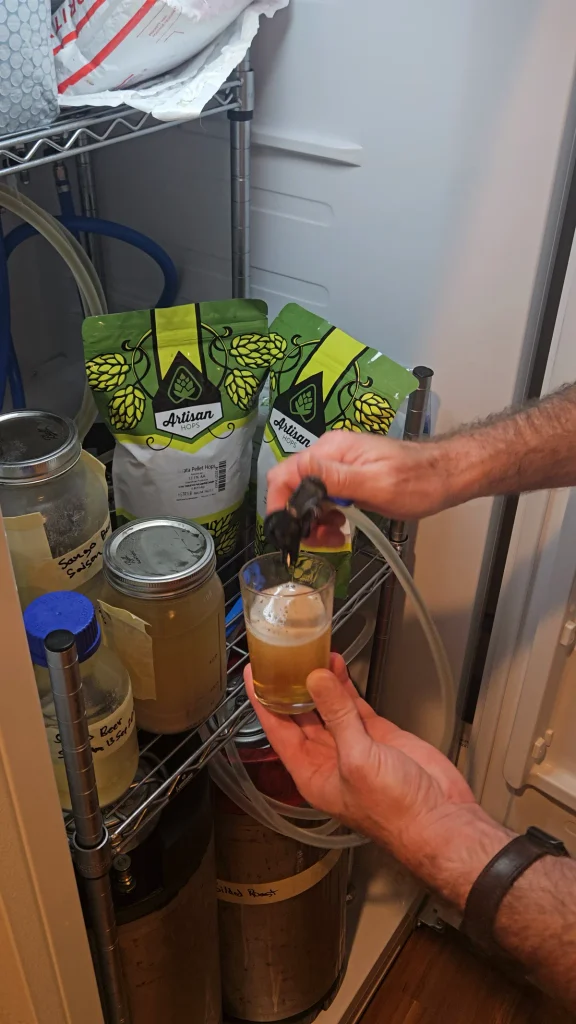
How did I carbonate it?
Set-and-forget — set the pressure once and let time do it, no shaking and no cranking it up: I set the serving keg’s regulator to 10–11 psi and kept the fridge at 3.3 °C (38 °F). At that temperature, that works out to about 2.4 volumes of CO₂ once it settles — the target in my recipe. “Volumes” describes how much CO₂ is dissolved in the beer; I did not measure it directly. The keg stayed at that pressure for roughly two weeks before the verdict tasting, without shaking or a high-pressure carbonation step.
What’s the verdict?
I tasted it properly on 1 November, 15 days after it came off the beans and began carbonating in the serving keg.
Appearance: Clear golden yellow. Not much of a head — the beer’s weakest point. I suspect the coffee oils contributed, but I can’t pin the cause on them from this batch alone.
Aroma: Still very, very heavy coffee. It outshines any other aroma in the beer. If you handed this glass to someone without telling them anything, “coffee” would be the first and loudest word, and it wouldn’t be close.
Mouthfeel: Light-bodied.
Flavor: The coffee note leads, with hints of chocolate and a caramel or toffee note underneath — that last one wasn’t in the early tastings; it showed up in the finished beer. Very light on the bittering; the estimated 19 IBU stay in the background.
My score: 3.6 / 5. The coffee addition did what I asked of it. The head retention costs it, and the base beer is simple — which is what it was built to be. I’ve only had a few pours so far; there’s still plenty in the keg.
Is the coffee fading?
About two weeks after the transfer off the beans, I still wasn’t noticing a drop in the coffee aroma or flavor. The beer stays in my keg fridge at 3.3 °C (38 °F), served with party taps (simple plastic taps on a hose, straight off the keg). I’ll keep tasting as it ages and update this post if the coffee character changes noticeably.
Would I brew it again?
Yes. I’d keep the base beer, and I’d happily use the same Kaldi Brazil beans again. For the next brew, I’ve narrowed the coffee addition down to two methods: cold-brew concentrate added at packaging, or a vodka coffee tincture.
Both let me add a little to the finished beer, taste, and gradually work toward the coffee character I want. I could test measured additions in a glass before deciding how much to add to the keg, or even adjust individual glasses as I serve them.
Which would you try next: cold-brew concentrate or a vodka coffee tincture? If you’ve brewed with either, tell me how it turned out. I’ll put those two methods to a reader vote; the winner gets brewed and posted.
Or I could layer one of them on top of the whole-bean infusion I used here — if I wanted more coffee character after taking the beer off the beans, add a little cold-brew concentrate or tincture and taste again. This batch used whole beans only. And if I change two things at once, I won’t pretend I know which one did it.
Whole beans in the keg worked. For the rebrew, I may change the method or the dose, and I’ll record those changes.
Follow along on Instagram @alechemylab, where this beer’s transfer and tasting days were posted as they happened. The other big project in the Lab is the Saison Yeast Trials — 26 yeasts compared in paired, split-batch trials.
Appendix: the full recipe — Gilded Roast V1 (coffee blonde ale)
The recipe settings and recorded batch measurements are below. Calculated and estimated values are labeled separately. The recipe stays V1 until I change the recipe itself. The recipe is shared on Brewfather too, if you want to import it.
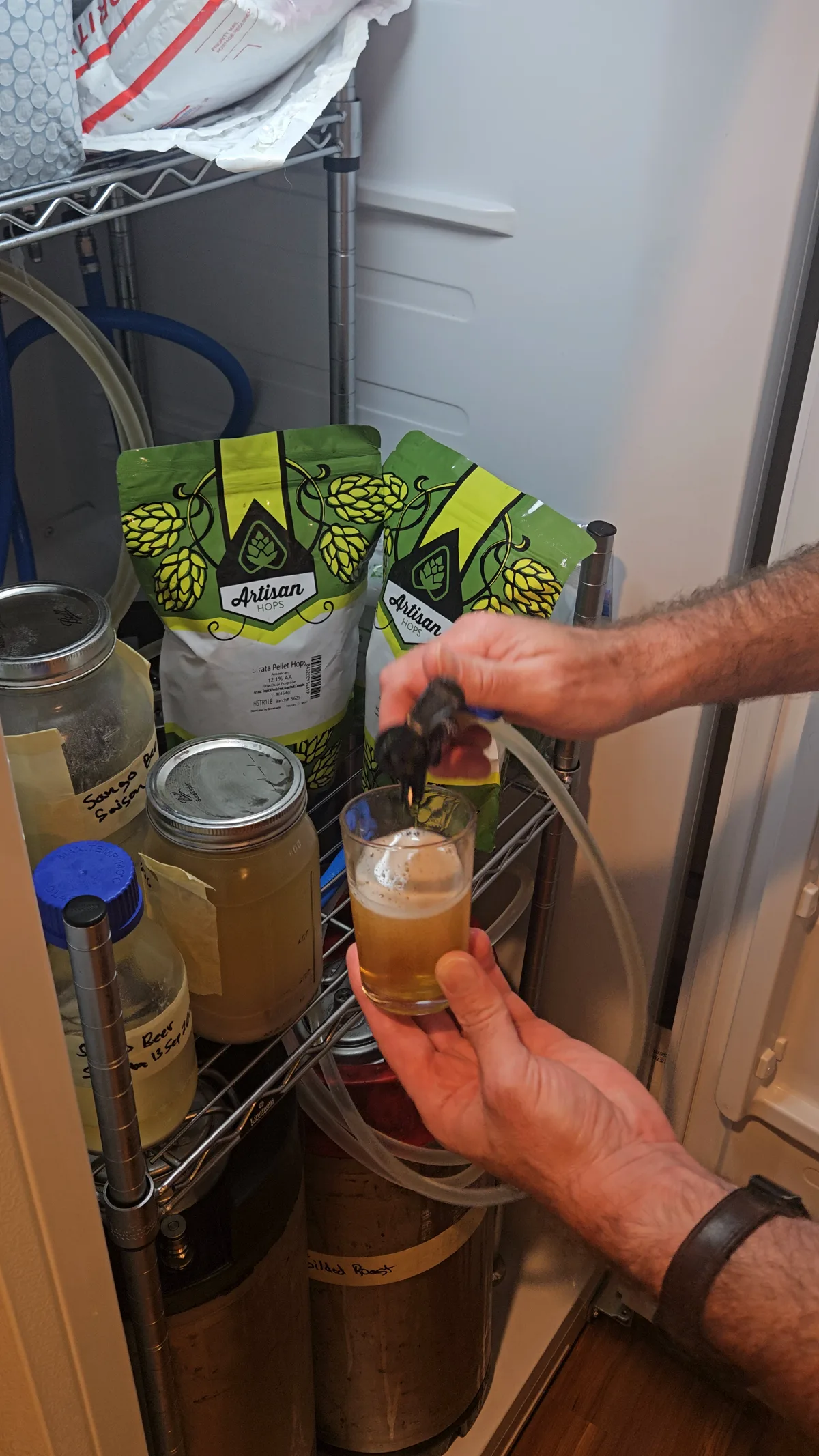
Gilded Roast V1 — Coffee Blonde Ale
Ingredients
Method
- Mash at 67 °C (153 °F) for 60 min in a bag inside a cooler (stovetop setup). Mash water 5.09 L (1.34 US gal), strike about 79.7 °C (175 °F).
- Sparge with 9.33 L (2.46 US gal) at 73.9 °C (165 °F); collect 13.5 L (3.57 US gal) pre-boil.
- Boil 60 min: Magnum at the start, Irish moss at 10 min, yeast nutrient at 5 min. Post-boil about 10.09 L (2.67 US gal).
- Chill and transfer 9.28 L (2.45 US gal) to the fermenter (BrewDemon). Pitch 1/2 packet WLP001.
- Ferment at 18.9 °C (66 °F), ramping to 20.5 °C (69 °F), to FG 1.009.
- Coffee addition: put the 56 g of whole beans, unsanitized, into a CO2-purged keg and transfer the finished beer onto them (14 October 2026). Hold at 3.3 °C (38 °F).
- Taste daily from 24 hours. At about 72 hours (17 October), transfer keg-to-keg into the serving keg, off the beans.
- Carbonate set-and-forget at 10–11 psi and 3.3 °C (38 °F) — about 2.4 volumes of CO2 at equilibrium (estimated, not measured).