Author: Alechemy Lab

  • Saison Yeast Trial #1: SafAle BW-20 vs. LalBrew Wit Belgian

    Saison Yeast Trial #1: SafAle BW-20 vs. LalBrew Wit Belgian

    One Sunrise Saison wort, two wheat yeasts — a three-point decision

    SafAle BW-20 edged LalBrew Wit Belgian by three points in the first Saison Yeast Trial: 55 to 52. Both finished at 1.002, and neither gave me the full citrus, tropical fruit, and Saison yeast character I was chasing. BW-20 advances, and I preferred it in both tastings. This is the first pairing in the Wheat & Phenolic category, using Sunrise Saison V1 as the shared wort. The scores came from the second tasting, when I knew which was which; the first was blind and unscored.

    The verdict

    YeastSafAle BW-20LalBrew Wit Belgian
    Score55/10052/100
    OG → FG1.045 → 1.0021.045 → 1.002
    Apparent attenuation95.6%95.6%
    AppearanceYellow, white head, clearerYellow, white head, hazier
    ResultAdvances to the category finalEliminated from the Saison Yeast Trials

    Scores are from my one identified, scored tasting; the earlier blind tasting was unscored.

    OG is the gravity reading before fermentation, FG the reading after. Apparent attenuation is how completely the yeast fermented the sugars, worked out from those two readings — 95.6% is very dry.
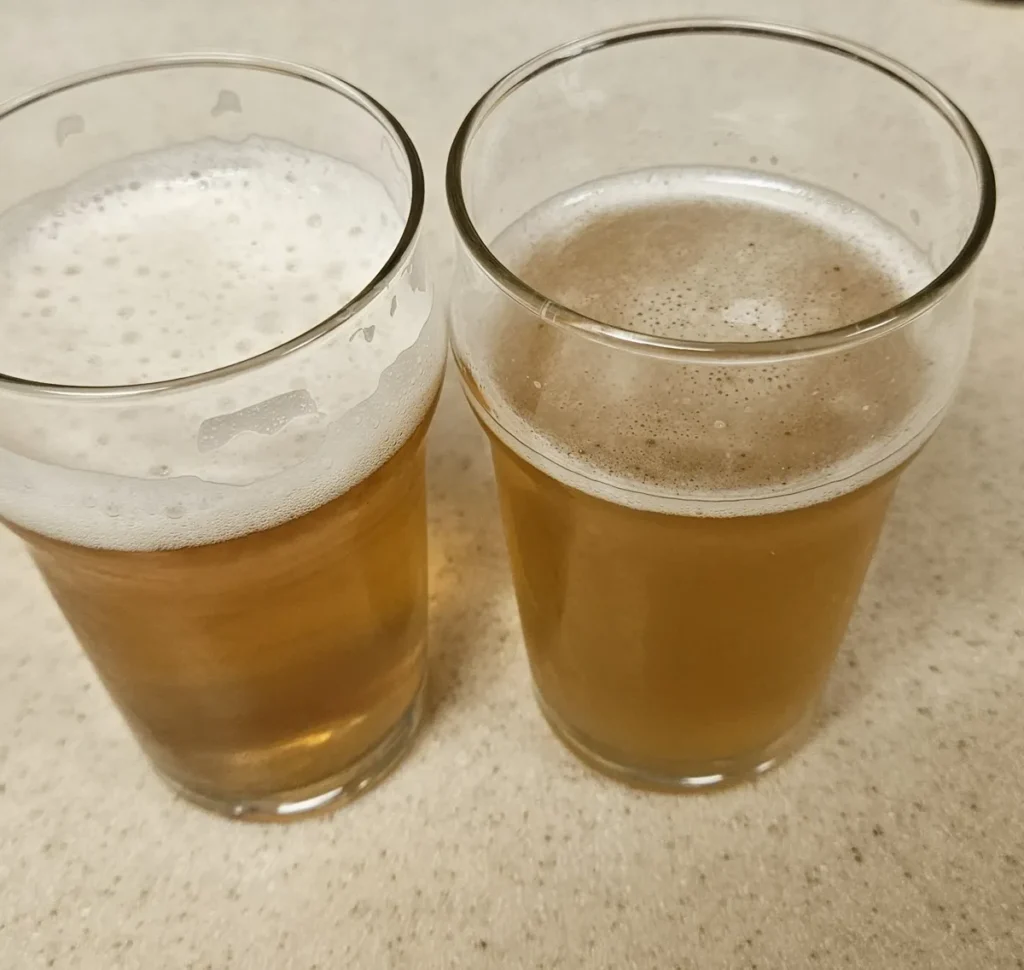
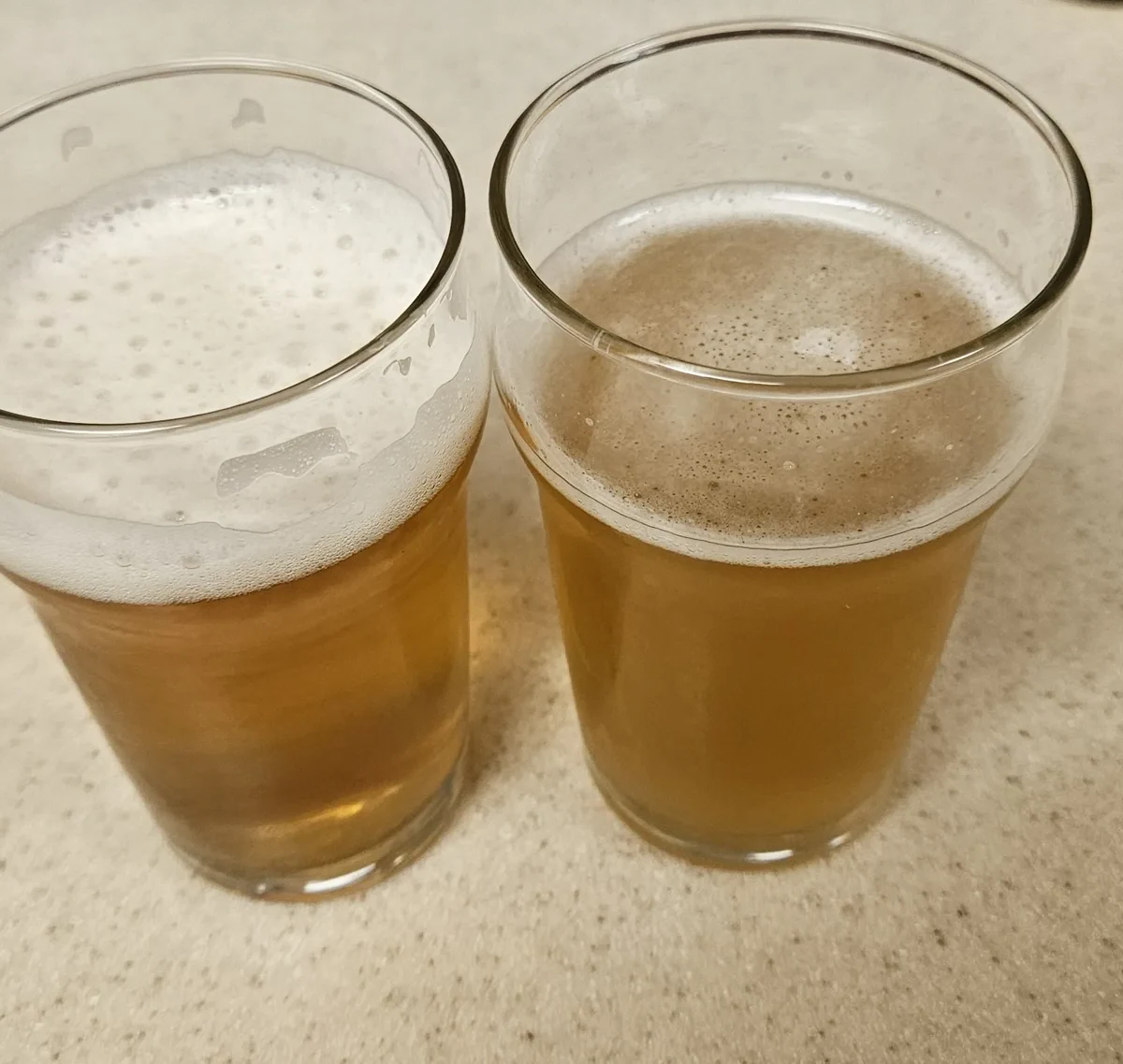
    Two glasses of Sunrise Saison side by side — SafAle BW-20 on the left, clearer; LalBrew Wit Belgian on the right, hazier.

    The finished beers in matching glasses: BW-20 on the left, clearer; Wit Belgian on the right, hazier. Both poured with a white head.

    What beer was I trying to brew?

    I wanted definite citrus, more tropical fruit, and the spicy, phenolic (peppery, clove-like) character I associate with Saison yeast. The spices were especially important to the direction I had in mind.

    The recipe behind it, in general terms: a pilsner, two-row, and white wheat base with smaller amounts of Munich and amber malt, flaked oats, and dextrose to keep it dry. Magnum for bittering, Saaz late, then a Pacific Jade, Sorachi Ace, and Wakatu hop stand, with coriander seed and orange peel at flameout. The full recipe is at the end of this post.

    I had brewed with LalBrew Wit Belgian before. BW-20 was new to me, which made it interesting to try. I saw them as two similar wheat-oriented options, so pairing them felt like a useful comparison. I expected some spice and pepper, and I was surprised that Wit did not bring more citrus to the finished beer.

    The audience voted this pairing first on Instagram; the vote decided the order of the trials.

    How was the trial run?

    This was brewed on 27 July 2026 and carried past midnight into the 28th — one wort, split between two iGulu S1 fermenters at about 4 L (1.06 gal) each.

    I brewed on my small stovetop setup, heating water in a roughly 19 L (5 gal) stainless steel pot and mashing in a small cooler. Preheating the cooler helped: I put a smaller amount of hot water in it while the strike water finished heating, which reduced the temperature drop when the strike water went in.

    The awkward part was grain handling. For this batch the grain went loose into the cooler, and afterwards I dumped the whole mash into a bag to filter out the grains. It worked, but it was clumsy. On Trial #2 I put the bag in the cooler from the start, and that worked much better.

    I used an auto-siphon to transfer the wort from the pot, filling the two fermentation vessels to matching levels. Each received 2.75 g (about 1/4 of a packet) of weighed dry yeast, pitched directly at 20 °C (68 °F).

    Both iGulu units were set to the same temperature program. The recorded profile started at 20 °C (68 °F), rose toward 22 to 23 °C (72 to 73 °F), and held before a later cold crash. I selected the lowest fermentation-pressure setting available, which I remember as roughly 2 to 3 psi. That pressure is a recollection rather than a precise logged value.

    What did fermentation show?

    BW-20 showed visible activity by 16 hours after pitching. At 20 hours, its krausen — the foam on top of the fermenting beer — was at least about 2.5 cm (1 in) high. Wit had no visible activity in those early notes. By 40 hours, I could see activity in Wit, although it had not formed a krausen yet.

    At about 58 hours, BW-20 had reached the gas-release connection and fallen back, while Wit was forming a thin layer of foam. The BW-20 foam interrupted operation and needed attention. I fitted a sanitized spare lid, reconnected the unit, and cleaned the original lid. The swap took at most about a minute; I left the fermentation program running throughout.
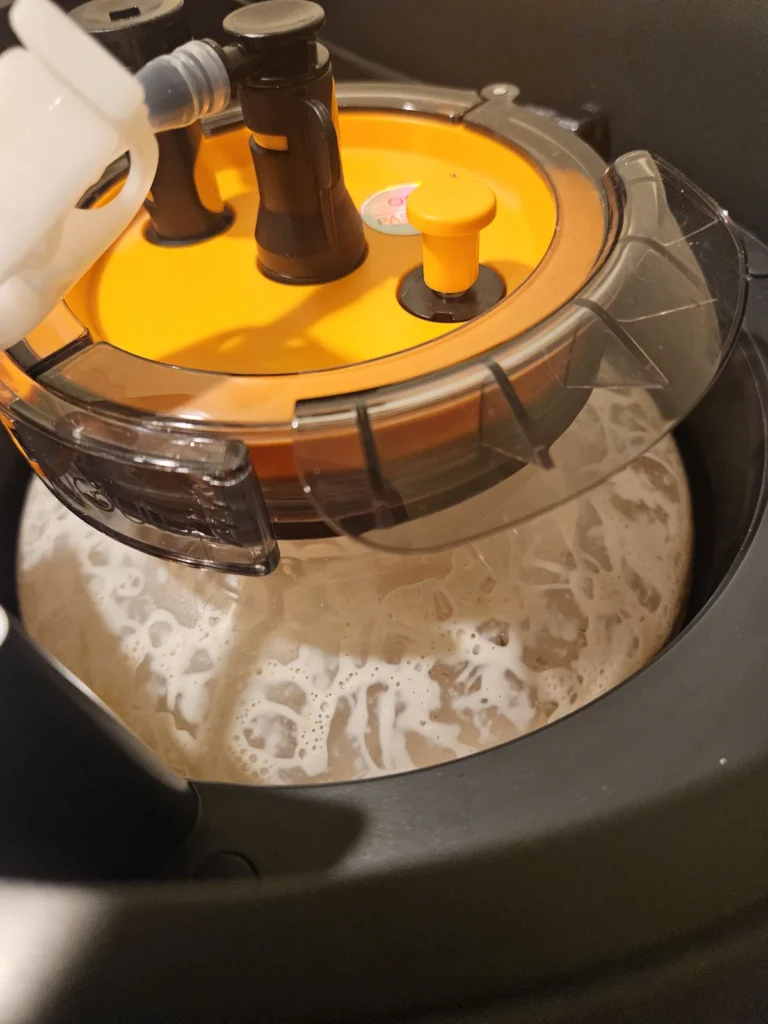
    iGulu S1 fermenter about 58 hours after pitching, SafAle BW-20 foam residue high inside the vessel.

    SafAle BW-20 at approximately 58 hours after pitching: foam residue high inside the vessel.
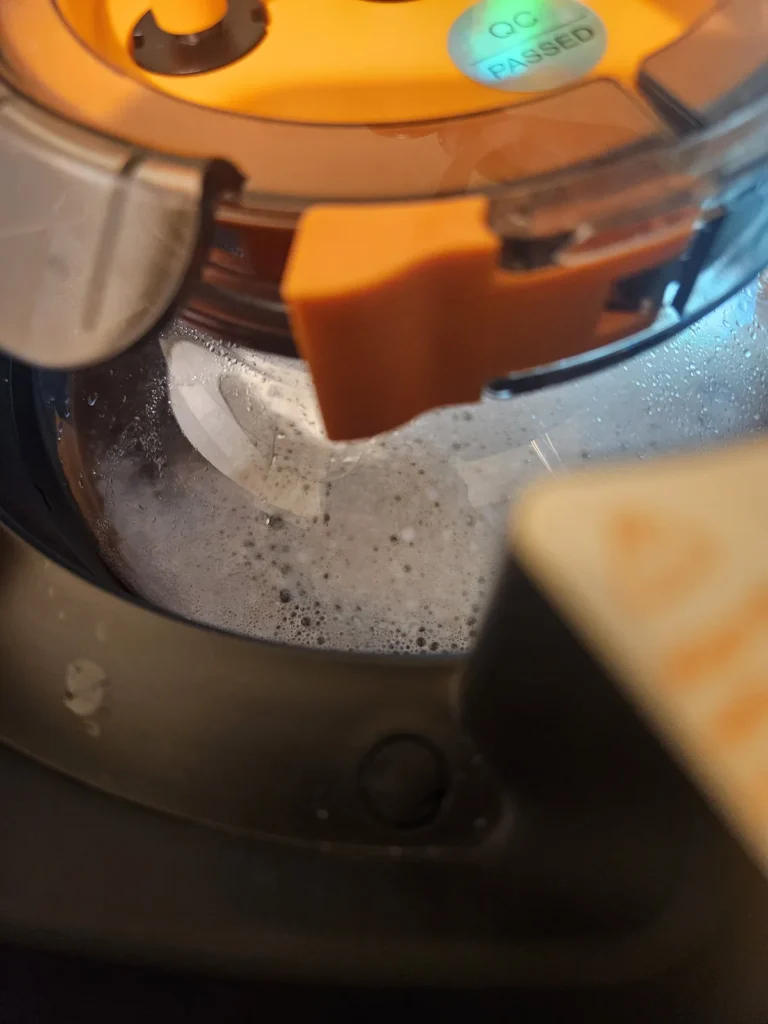
    iGulu S1 fermenter about 58 hours after pitching, LalBrew Wit Belgian with a thin layer of foam on the beer.

    LalBrew Wit Belgian at approximately 58 hours after pitching: a thin layer of foam on the beer.

    The photos document visible foam, not gravity or fermentation completion.

    That extra handling on the BW-20 side belongs in the comparison. The shared program was the plan, but one vessel needed an intervention. The visible activity also does not tell me exactly when either beer began or completed fermentation. I did not have a continuous gravity trace.

    I measured the final gravity with a hydrometer. Both beers were recorded at 1.002, so the endpoint reading did not separate them despite the very different early foam activity.

    How did I taste them?

    The beers never left their fermentation vessels — conditioning, carbonation, and serving all happened in the iGulu units. For carbonation, I connected CO2, set it to 15 psi, and left it there. I was aiming for about 2.7 volumes of CO2; at 3 to 4 °C (37 to 39 °F), 15 psi works out to roughly 2.8 to 2.9 volumes once the beer reaches equilibrium, so it likely finished a touch more carbonated than the target.

    I was the only taster in both sessions. The first tasting was blind and unscored. About ten days later, I tasted again knowing which yeast was in each glass and scored both beers in that one session. The 55 and 52 totals come from that later, identified tasting, held in early September — roughly six weeks after brew day.

    I used matching glassware and similar pour sizes, with the beers at the same temperature and carbonation conditions. My slight preference for BW-20 stayed consistent across the two sessions. There are no numerical scores from the initial blind tasting to compare with the later totals.

    I also tasted Sango Saison as an informal reference for the general Saison direction. Even that beer was less fruity and less expressive in Saison character than my ideal. It was a reference, rather than a third entry in this scored trial.

    Where did the three points come from?

    CategoryAvailableBW-20Wit Belgian
    Aroma201211
    Flavor301816
    Mouthfeel and finish1599
    Recipe fit251010
    Overall impression1066
    Total1005552

    The entire gap came from aroma and flavor. BW-20 had a little more citrus, especially in the aroma, although the citrus was still light. That earned it one extra aroma point. There may also have been a slightly smoother overall flavor impression, though that difference was subtle and harder for me to name. BW-20 received two more flavor points.

    Both beers were yellow with a white head. BW-20 was clearer and Wit Belgian was hazier. Their flavor profiles were close, with light citrus, spice, and pepper. I described both as lively, refreshing, and light in mouthfeel, and gave them the same mouthfeel-and-finish score.

    A three-point lead was enough for me to advance BW-20 because it matched my preference in both tastings. This is one brewer’s decision from one batch and one scored session. I would not use it to rank these yeasts universally.

    Why did recipe fit stay low?

    Both beers scored 10 out of 25 for recipe fit. I wanted more of the spicy, phenolic impression I associate with Saison yeast, alongside the spices I had added. I also wanted more tropical fruit and a stronger citrus aroma. Neither version really reached that picture.

    Choosing Wit because it was Belgian had made sense to me when I was thinking about a Belgian Saison direction. Tasting the result made me think harder about the specific strain and what I wanted it to contribute. The yeast was the deliberate change; the wort was the same. The handling wasn’t quite identical — BW-20’s lid swap saw to that.

    I could still see myself building a recipe around a wheat or Wit strain. That would mean thinking about the beer that works with that yeast, rather than expecting this recipe to produce the same character with every strain. If I want to know what a different fermentation temperature does, that would need its own comparison.

    Would I brew it again?

    Not this beer as it stands. It wasn’t bad, but it wasn’t amazing either, and I expect there are better yeasts for this recipe still ahead in the trials. That’s the point of running the comparisons instead of guessing.

    I would use BW-20 again — in a wheat-style beer built for it, where its spice, pepper, and light citrus lead the beer instead of playing support for a Saison character it only partly delivered.

    What happens to the loser?

    Wit Belgian is eliminated from the Saison Yeast Trials. That’s the format: lose your pairing and you leave the series. It could still come back in a different experiment one day — just not in this one.

    What happens next?

    This trial belongs to Wheat & Phenolic, the current category, which has three paired comparisons. Trial #2, SafAle W-68 versus LalBrew Munich Classic, has been brewed and tasted; its post follows this one. The third pairing is SafAle WB-06 versus SafAle T-58. I am keeping the same Sunrise Saison recipe across these three wheat-category trials.

    After those comparisons, I plan to develop a new recipe tailored more closely to the wheat strains. The current plan is a purpose-built Yuzu Saison. I will brew one wort, split it three ways, and pitch the three trial winners separately to choose the wheat-category winner on that new recipe. BW-20 goes through to that final.

    I will probably revise Sunrise Saison for the next yeast category, which is likely to be Saison & Farmhouse. Each category will work toward a winner before I move on. Once all the category winners are selected, I plan to compare them across categories.

    For future tastings, I want to keep the same sequence: a blind, unscored tasting first, followed about ten days later by an identified tasting with scores. That gives me an initial preference to return to when I sit down with the score sheets again.

    BW-20 took this one 55–52. Have you brewed with either strain? What citrus or spice character did you get, and at what temperature? Comments are open below.

    Follow the trials as they happen on Instagram @alechemylab. New to the Lab? The Saison Yeast Trials overview explains the whole series — and the rest of the trials live in the Yeast Trials archive.

    Which yeast won Trial #1, and by how much?

    SafAle BW-20 won Trial #1, 55–52 over LalBrew Wit Belgian, in my single identified scored tasting. Both used the same Sunrise Saison V1 wort. The three-point gap came from aroma (12–11) and flavor (18–16); the other categories tied. Both finished at 1.002. BW-20 advances; Wit Belgian is eliminated.

    What was different between the two beers?

    The beers were similar: SafAle BW-20 had slightly more citrus aroma and possibly a slightly smoother flavor; LalBrew Wit Belgian was hazier. BW-20 showed visible activity by 16 hours, compared with Wit by 40 hours. At about 58 hours, BW-20 had high foam residue, while Wit had developed a thin foam layer.

    Would you brew with BW-20 again?

    Yes — but not in Sunrise Saison V1. I would use BW-20 again in a wheat-style beer built for it, where its spice, pepper, and light citrus lead instead of supporting a Saison character it only partly delivered. I would not brew Sunrise Saison V1 again as it stands: it was not bad, but it was not amazing either.

    What stayed the same in the method?

    Sunrise Saison V1 wort, yeast dose, and temperature program were matched. Each iGulu S1 received about 4 L (1.06 US gal) and 2.75 g (about 1/4 packet) of dry yeast at 20 °C (68 °F). The yeast was the change I made on purpose, but BW-20 needed a lid swap, so the handling wasn’t identical. Both used 15 psi carbonation.

    What would I need for a similar trial?

    Split Sunrise Saison V1 into about 4 L (1.06 US gal) per fermenter, with 2.75 g (about 1/4 packet) each of SafAle BW-20 and LalBrew Wit Belgian. Use the temperature outline; exact ramp and hold timings are not supplied. Use pressure-rated equipment for carbonation. Taste blind and unscored first, then score identified about ten days later with the published rubric.

    Appendix: the original recipe — Sunrise Saison V1

    This is the original Sunrise Saison V1 used for Trial #1. A note on versions: the recipe stays V1 across yeast changes — the version only changes when I change the recipe itself, so later trials on this same recipe are still V1 even with different yeast pitched.

    • Brewed: 27 July 2026
    • Target volume: 8 L (2.1 gal). Brewfather records 8.25 L (2.18 gal) into fermentation in total; my split was about 4 L (1.06 gal) per vessel
    • OG / FG: 1.045 / 1.002 (both beers)
    • Calculated ABV: 5.6%
    • Apparent attenuation: 95.6% (both beers)
    • Estimates: 27 IBU, 5 SRM
    • Mash: 65 °C (149 °F) for 60 minutes, then 77 °C (171 °F) for 10 minutes
    • Boil: 60 minutes
    • Yeast: SafAle BW-20 in one half and LalBrew Wit Belgian in the other; each received 2.75 g (about 1/4 of a packet) of weighed dry yeast, pitched directly into about 4 L (1.06 gal) of wort.
    • Fermentation: both iGulu S1s started at 20 °C (68 °F), rose toward 22 to 23 °C (72 to 73 °F), and held before a later cold crash. Fermentation pressure was recalled as roughly 2 to 3 psi. BW-20 required the sanitized lid swap described above.
    • Conditioning and carbonation: the beers stayed in their fermentation vessels. CO2 was set to 15 psi at 3 to 4 °C (37 to 39 °F). The target was 2.7 volumes; the equilibrium estimate was roughly 2.8 to 2.9 volumes, rather than a measured carbonation value.
    FermentableAmount
    Pilsner malt585 g (20.6 oz)
    Premium 2-row malt293 g (10.3 oz)
    White wheat malt210 g (7.4 oz)
    Dextrose190 g (6.7 oz)
    Munich I malt133 g (4.7 oz)
    Amber malt87 g (3.1 oz)
    Flaked oats59 g (2.1 oz)
    HopAmountAddition
    Magnum4 g (0.14 oz)60 minutes before end of boil
    Saaz6 g (0.21 oz)10 minutes before end of boil
    Pacific Jade, Sorachi Ace, Wakatu4 g (0.14 oz) each15-minute hop stand at 76.7 °C (170 °F)

    At flameout: 2 g (0.07 oz) coriander seed, 3 g (0.11 oz) bitter orange peel, and 4 g (0.14 oz) sweet orange peel.
  • Gilded Roast: A Coffee Blonde Ale with Whole Beans in the Keg

    Gilded Roast: A Coffee Blonde Ale with Whole Beans in the Keg

    A friend asked for a coffee blonde. I’d never brewed one — so I built one.

    The beans went in unsanitized, and the transfer waited on an empty CO₂ tank.

    The verdict


    Gilded Roast V1
    My score3.6 / 5
    StyleBlonde ale with coffee
    OG → FG1.046 → 1.009
    ABV / IBU / SRM4.9% calculated / 19 estimated / 4 estimated
    Coffee56 g (2 oz) whole Kaldi Brazil beans in 8.7 L (2.3 US gal); about 6.4 g/L (24 g per US gallon), 72 hours; fridge set to 3.3 °C (38 °F)
    Carbonation10–11 psi at 3.3 °C (38 °F); approximately 2.4 volumes estimated

    Gilded Roast is a 4.9% blonde ale finished with 56 g (2 oz) of whole coffee beans in 8.7 L (2.3 US gal) of beer, transferred off the beans after 72 hours — I scored it 3.6 out of 5. The result is a clear golden blonde with a coffee aroma that outshines everything else in the glass; coffee leads the flavor too, backed by a little chocolate and caramel-toffee, and the weak point is the head: there isn’t much of one.

    (OG and FG are the gravity readings before and after fermentation — shorthand for how much sugar was in the wort and how much was left at the end. In a hurry? Jump to the full recipe at the end.)

    Why brew a coffee blonde?

    Most coffee beers are stouts and porters, where the roasted malt and the coffee pull in the same direction and cover for each other. A blonde has nowhere to hide: a light, clean base beer, and coffee sitting right on top of it. That’s the version of the problem a friend put in front of me when he said he wanted a coffee blonde — and since I’d never brewed one, I did some research and developed the recipe myself.

    The name is the beer in two words. Gilded is the golden blonde underneath; Roast is the coffee on top.

    For the beans, I didn’t go shopping for anything exotic. I used Kaldi Brazil beans — the coffee I regularly drink myself, which I buy locally.

    What did I brew?

    The full recipe card is at the end of this post. In general terms: a simple blonde ale built on premium two-row with a small amount of caramel 10L malt for a touch of color and sweetness, a single Magnum bittering addition at the start of the boil, and distilled water built up to a soft blonde profile. I fermented it with White Labs California Ale Dry (WLP001), a clean yeast that stays out of the way.

    How did brew day go?

    This was brewed on 28 September 2026 on my small-batch stovetop setup. The grain mashed at 67 °C (153 °F) for 60 minutes in a cooler with a bag inside it — the bag holds the grain so I can lift it out and sparge (rinse the grain with hot water to wash out the remaining sugars). It’s the arrangement I’ve settled on for these batches; my first yeast trial mashed loose in the cooler and filtered afterwards, which was clumsy by comparison. After a 60-minute boil with the one hop addition at the start, I chilled the wort and pitched the yeast. From a planned 9.5 L (2.5 US gal) batch, 9.28 L (2.45 US gal) went into the fermenter, a BrewDemon (a small conical fermenter — the foil-wrapped vessel in the transfer photos).

    Fermentation ran at 18.9 °C (66 °F), ramping to 20.5 °C (69 °F). By the time the beer was ready to move, the gravity had settled at 1.009 and was holding there — that’s how I knew it was finished.

    How much coffee do you add to beer?

    For this batch: 56 g (2 oz) of whole beans in about 8.7 L (2.3 US gal) of beer — roughly 6.4 g/L (24 g per US gallon) — steeped for 72 hours at fridge temperature.

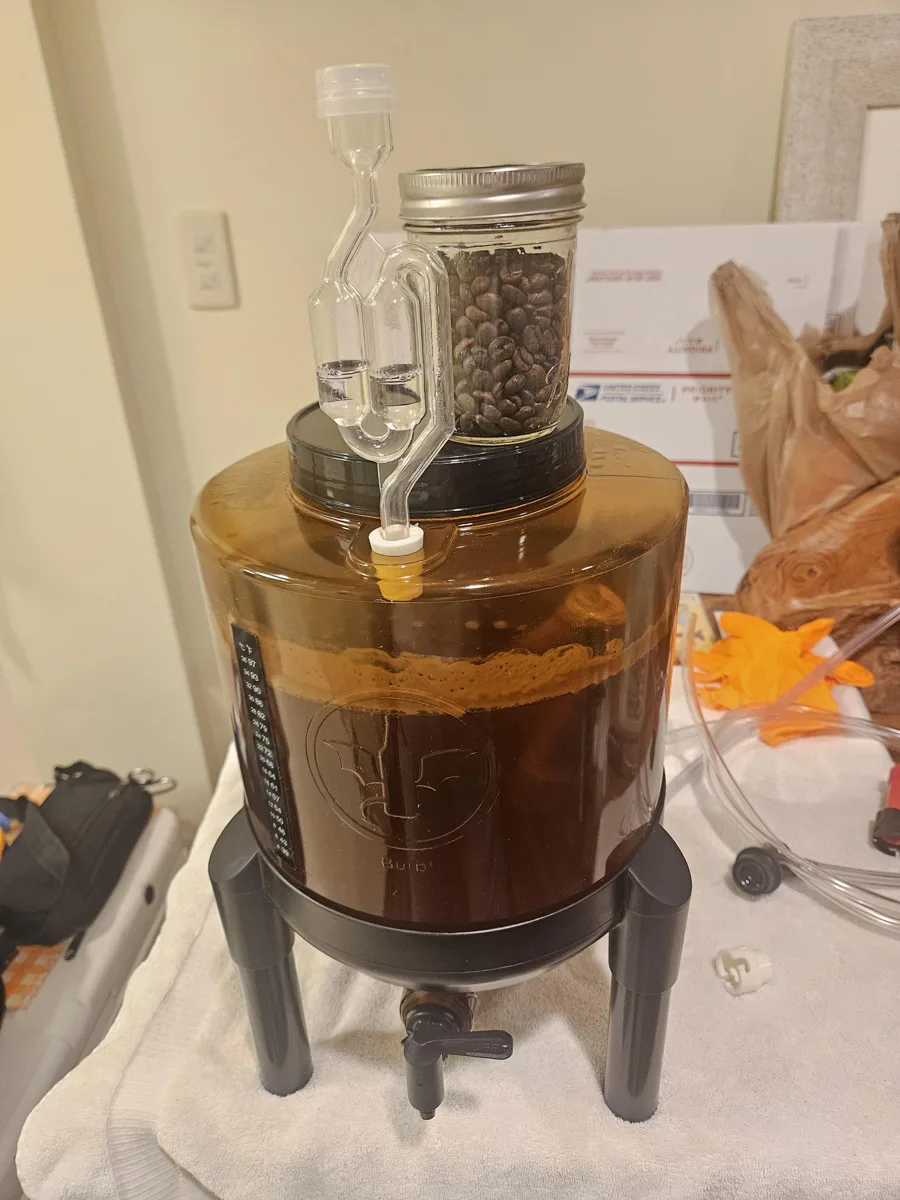
    I put whole, uncrushed beans into a keg and transferred the finished beer onto them. The plan was to begin tasting at 24 hours and transfer the beer off the beans when the flavor caught up to the aroma. I expected that to take around 36–48 hours, with about 72 hours as the outer limit.

    Whole beans suited that plan: I could taste daily, then move the beer into another keg and leave the beans behind. I wanted a clear coffee character without an acrid edge. The daily tastings, rather than a fixed extraction time alone, would tell me when it was ready.

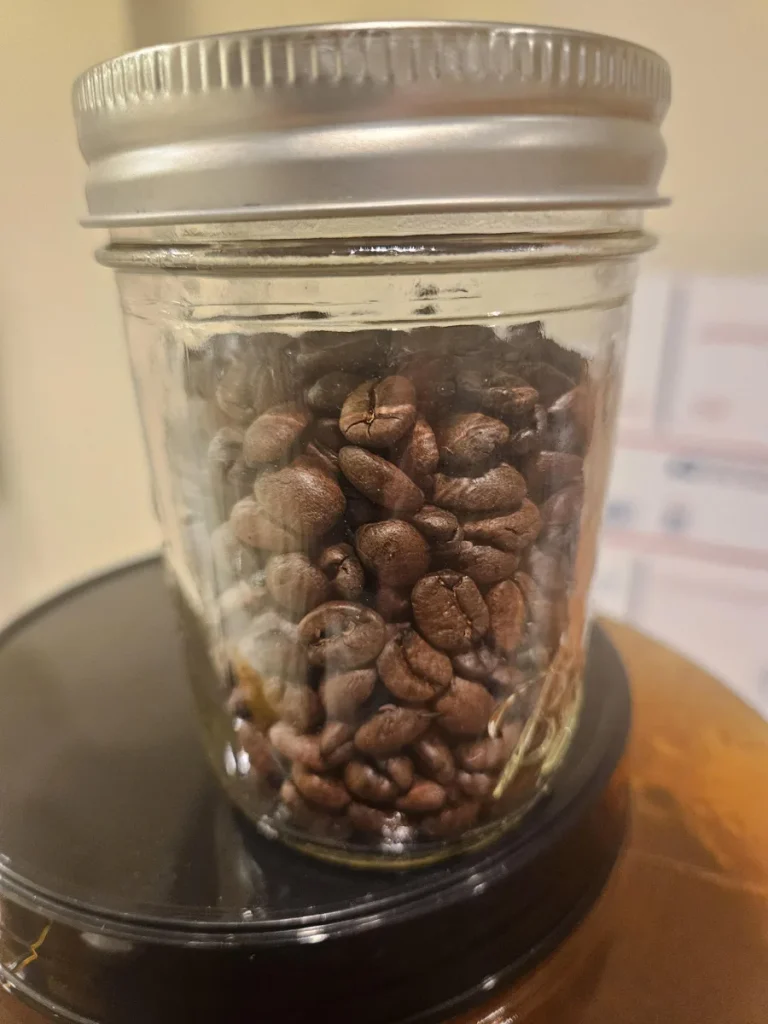
    Whole coffee beans for the coffee blonde ale, in a jar.
    The beans: Kaldi Brazil, whole, straight from the bag.

    some always stays behind with the sediment. If you’re scaling this, dose against the beer in the keg, not the batch size on paper.

    The transfer that had to wait

    The plan was to transfer the finished beer onto the beans around 11 October. My CO₂ tank had other ideas — it was empty, and getting a replacement CO₂ supply had just become slower and more expensive than it used to be. I wanted CO₂ available to purge the receiving keg before transferring the beer, so the beer waited in the fermentation chamber until a tank arrived, and the transfer happened on the evening of 14 October.

    One thing worth stating plainly, because it would be easy to assume otherwise: the beer was not cold crashing during that wait. It sat at fermentation temperature in the chamber. The cold crash — holding the beer cold so sediment drops out and it clears — came later, in the conditioning keg, with the beer already on the beans.

    How did I add the coffee?

    I didn’t sanitize the beans — they went into the conditioning keg whole, straight from the bag. I was counting on the alcohol in the finished beer. Whether that’s actually enough, I haven’t tested. This batch, at least, showed no sign of infection through the 1 November verdict tasting.

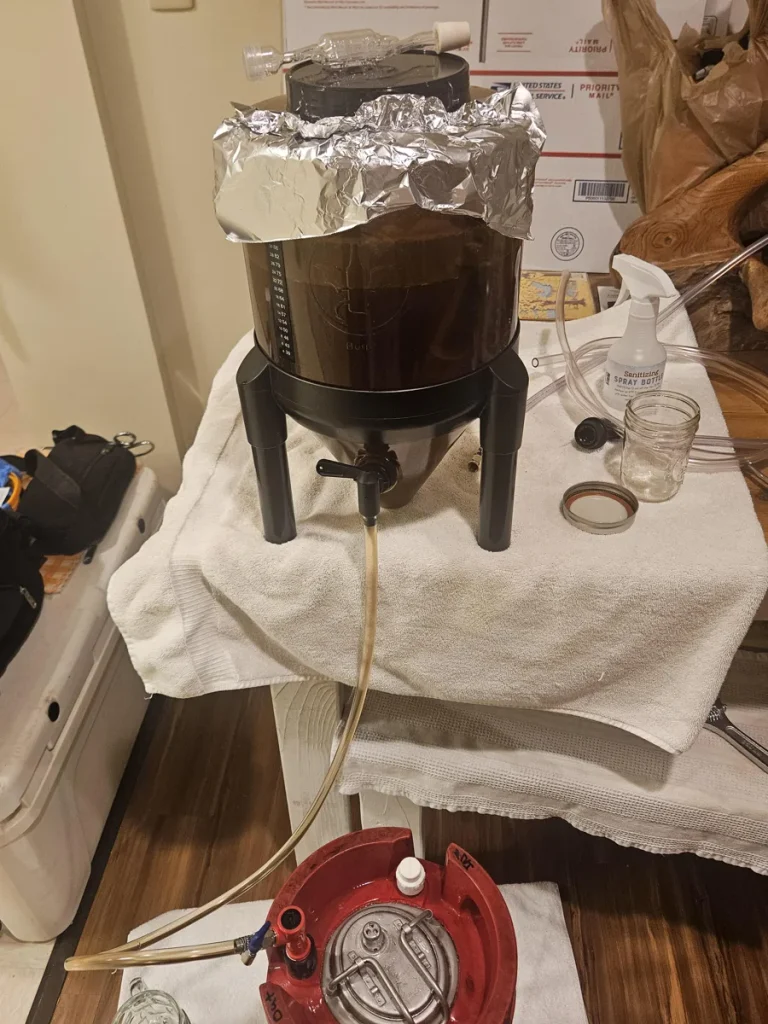
    I purged the conditioning keg with CO₂ first, then ran a line from the fermenter’s spout to the keg’s liquid post. The beer filled the keg from the bottom up through its floating dip tube, lid closed, and I vented the keg’s gas a little at a time as the beer came in to make room for it. It wasn’t a true closed transfer: there’s no gas line running back to the fermenter, so the keg side stayed closed and purged, but the fermenter side breathed — as the beer drained out, air was drawn in to replace it.

    Finished blonde ale draining from the fermenter into the conditioning keg.
    The transfer setup — the fermenter filling the conditioning keg from the bottom up.

    went into the fridge set to 3.3 °C (38 °F), so the cold crash and coffee extraction happened together as the beer cooled.

    How long do you leave whole coffee beans in beer?

    The beer went onto the beans on 14 October and came off on 17 October, tasted daily:

    Day 1 (24 hours): The aroma was already there — heavy coffee, like smelling the beans themselves, with a slight vanilla and roast note. The flavor lagged behind: light coffee, a touch of chocolate, a slight berry note, and an almost spicy edge. Good, but not enough yet.

    Day 2 (48 hours): The same profile, building. The flavor was closing on the aroma but hadn’t caught it.

    Day 3 (72 hours): The flavor matched the aroma. That’s the target I’d set before the beans went in — when the taste catches the smell, stop — so the beer came off the beans that evening, transferred keg-to-keg into the serving keg. No acrid or tannic edge at this dose and duration, which was the thing I’d been watching for in a base beer this light.

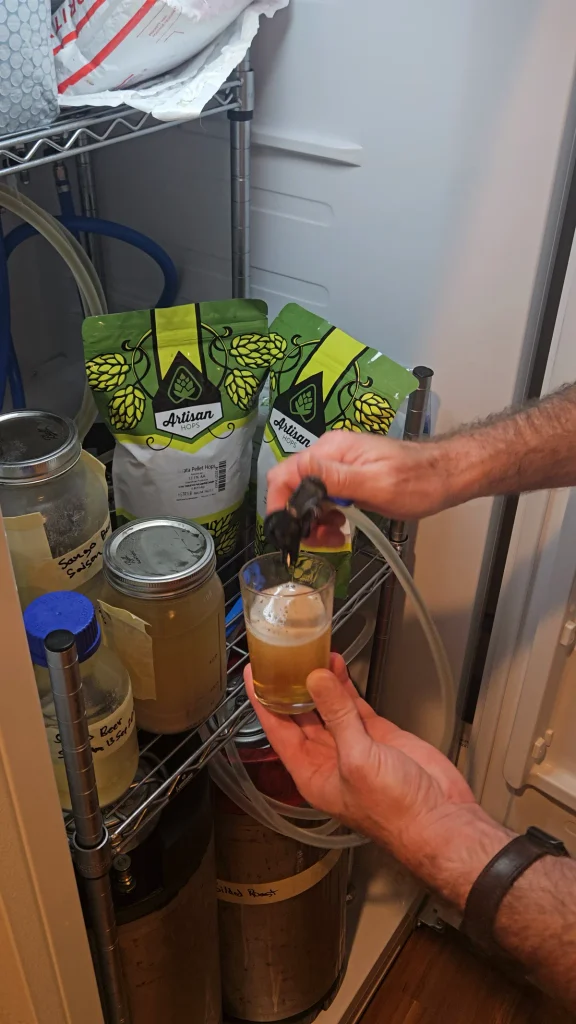
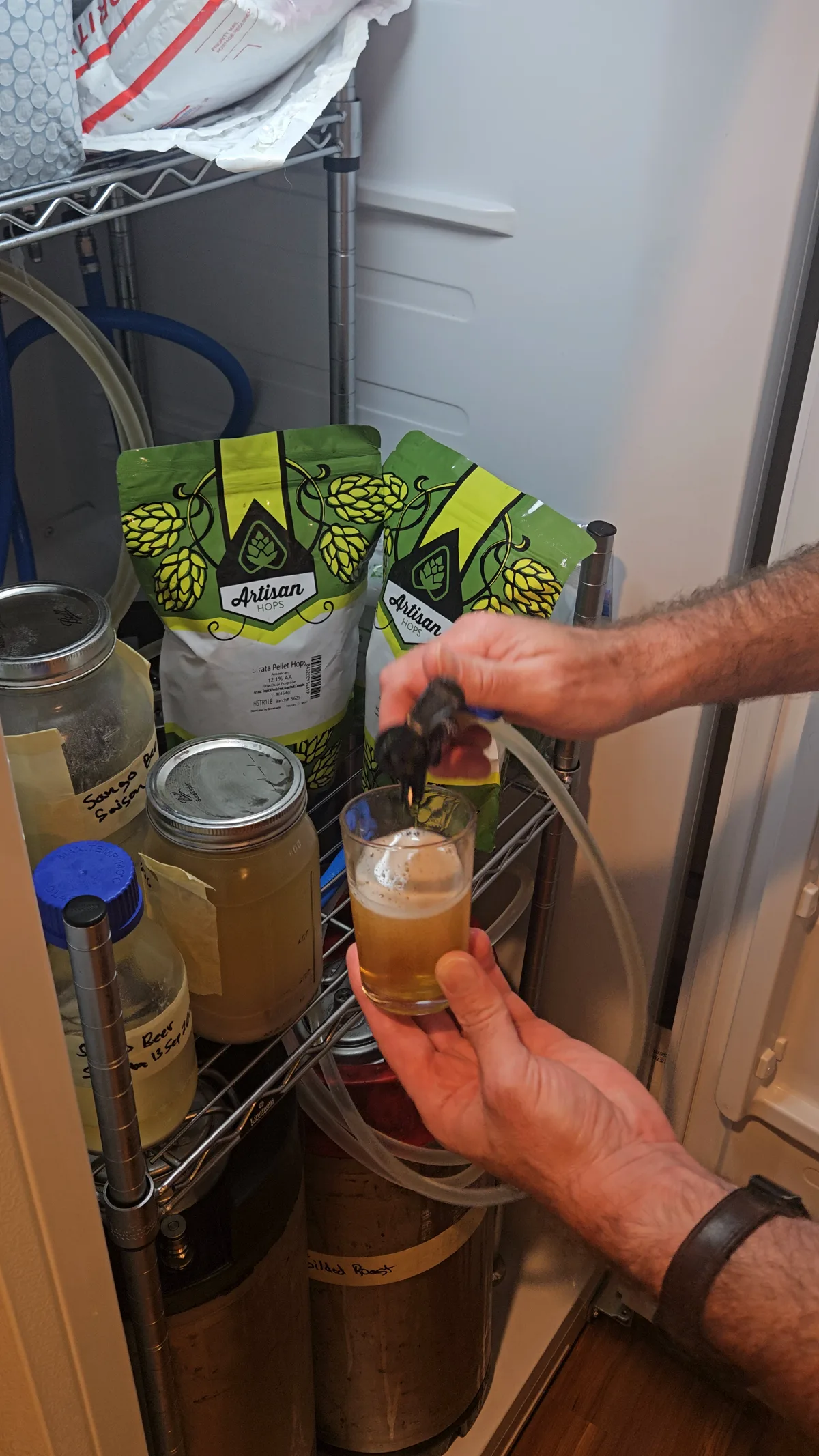
    Drawing a tasting sample of coffee blonde ale from the keg with a party tap.
    The daily tastings: a sample drawn straight off the keg.
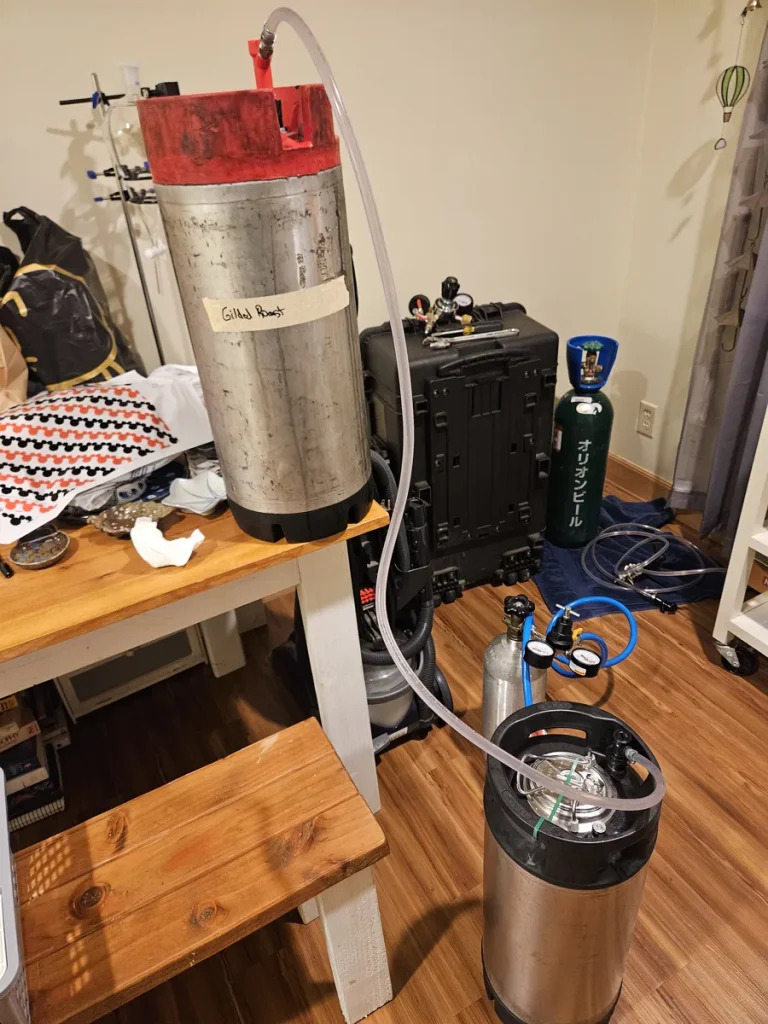
    Transferring the coffee blonde ale from the conditioning keg into the serving keg, off the beans.
    Day 3: keg-to-keg — off the beans and into the serving keg.

    How did I carbonate it?

    Set-and-forget — set the pressure once and let time do it, no shaking and no cranking it up: I set the serving keg’s regulator to 10–11 psi and kept the fridge at 3.3 °C (38 °F). At that temperature, that works out to about 2.4 volumes of CO₂ once it settles — the target in my recipe. “Volumes” describes how much CO₂ is dissolved in the beer; I did not measure it directly. The keg stayed at that pressure for roughly two weeks before the verdict tasting, without shaking or a high-pressure carbonation step.

    What’s the verdict?

    I tasted it properly on 1 November, 15 days after it came off the beans and began carbonating in the serving keg.

    Appearance: Clear golden yellow. Not much of a head — the beer’s weakest point. I suspect the coffee oils contributed, but I can’t pin the cause on them from this batch alone.

    Aroma: Still very, very heavy coffee. It outshines any other aroma in the beer. If you handed this glass to someone without telling them anything, “coffee” would be the first and loudest word, and it wouldn’t be close.

    Mouthfeel: Light-bodied.

    Flavor: The coffee note leads, with hints of chocolate and a caramel or toffee note underneath — that last one wasn’t in the early tastings; it showed up in the finished beer. Very light on the bittering; the estimated 19 IBU stay in the background.

    My score: 3.6 / 5. The coffee addition did what I asked of it. The head retention costs it, and the base beer is simple — which is what it was built to be. I’ve only had a few pours so far; there’s still plenty in the keg.

    Is the coffee fading?

    About two weeks after the transfer off the beans, I still wasn’t noticing a drop in the coffee aroma or flavor. The beer stays in my keg fridge at 3.3 °C (38 °F), served with party taps (simple plastic taps on a hose, straight off the keg). I’ll keep tasting as it ages and update this post if the coffee character changes noticeably.

    Would I brew it again?

    Yes. I’d keep the base beer, and I’d happily use the same Kaldi Brazil beans again. For the next brew, I’ve narrowed the coffee addition down to two methods: cold-brew concentrate added at packaging, or a vodka coffee tincture.

    Both let me add a little to the finished beer, taste, and gradually work toward the coffee character I want. I could test measured additions in a glass before deciding how much to add to the keg, or even adjust individual glasses as I serve them.

    Which would you try next: cold-brew concentrate or a vodka coffee tincture? If you’ve brewed with either, tell me how it turned out. I’ll put those two methods to a reader vote; the winner gets brewed and posted.

    Or I could layer one of them on top of the whole-bean infusion I used here — if I wanted more coffee character after taking the beer off the beans, add a little cold-brew concentrate or tincture and taste again. This batch used whole beans only. And if I change two things at once, I won’t pretend I know which one did it.

    Whole beans in the keg worked. For the rebrew, I may change the method or the dose, and I’ll record those changes.

    Follow along on Instagram @alechemylab, where this beer’s transfer and tasting days were posted as they happened. The other big project in the Lab is the Saison Yeast Trials — 26 yeasts compared in paired, split-batch trials.

    Appendix: the full recipe — Gilded Roast V1 (coffee blonde ale)

    The recipe settings and recorded batch measurements are below. Calculated and estimated values are labeled separately. The recipe stays V1 until I change the recipe itself. The recipe is shared on Brewfather too, if you want to import it.

    Gilded Roast V1 — Coffee Blonde Ale

    A 4.9% blonde ale finished with 56 g (2 oz) of whole coffee beans in the keg for 72 hours. Scored 3.6/5.
    Cook Time 2 hours 30 minutes
    Course: Beer Recipes

    Ingredients
      

    • 1.8 kg premium two-row 92.3%
    • 150 g caramel 10L malt 7.7%
    • 5.5 g Magnum hops 11.3% AA (60 min)
    • 1 g Irish moss 10 min
    • 1 g yeast nutrient 5 min
    • 1/2 packet White Labs California Ale Dry WLP001
    • 56 g whole Kaldi Brazil coffee beans uncrushed and unsanitized
    • Distilled water built to a blonde profile Ca 68 ppm, Cl 77 ppm, SO4 58 ppm

    Method
     

    1. Mash at 67 °C (153 °F) for 60 min in a bag inside a cooler (stovetop setup). Mash water 5.09 L (1.34 US gal), strike about 79.7 °C (175 °F).
    2. Sparge with 9.33 L (2.46 US gal) at 73.9 °C (165 °F); collect 13.5 L (3.57 US gal) pre-boil.
    3. Boil 60 min: Magnum at the start, Irish moss at 10 min, yeast nutrient at 5 min. Post-boil about 10.09 L (2.67 US gal).
    4. Chill and transfer 9.28 L (2.45 US gal) to the fermenter (BrewDemon). Pitch 1/2 packet WLP001.
    5. Ferment at 18.9 °C (66 °F), ramping to 20.5 °C (69 °F), to FG 1.009.
    6. Coffee addition: put the 56 g of whole beans, unsanitized, into a CO2-purged keg and transfer the finished beer onto them (14 October 2026). Hold at 3.3 °C (38 °F).
    7. Taste daily from 24 hours. At about 72 hours (17 October), transfer keg-to-keg into the serving keg, off the beans.
    8. Carbonate set-and-forget at 10–11 psi and 3.3 °C (38 °F) — about 2.4 volumes of CO2 at equilibrium (estimated, not measured).

    Notes

    Brewed 28 September 2026. OG 1.046, FG 1.009 (measured). ABV about 4.9% calculated; bitterness 19 IBU and color 4 SRM estimated. Brewhouse efficiency 75% (planning value). Mash pH 5.22 measured (5.28 predicted). Coffee dose is about 6.4 g/L (24 g per US gallon) against the roughly 8.7 L (2.3 US gal) of beer in the keg — dose against the beer in the keg, not the paper batch size.
  • 26 Yeasts, One Saison: The Saison Yeast Trials

    26 Yeasts, One Saison: The Saison Yeast Trials

    I love saisons. What I never did was nail down the yeast.

    I’ve brewed saison-style beers I liked, but not one where I could point at the yeast and say: that’s the one. So instead of guessing, I built a series of trials around twenty-six yeasts I already own, organized into six categories. Lose your pairing and you’re out. Each category’s initial pairings share one recipe; their winners meet on a new recipe built for the category final. I taste the beers blind and unscored first, then return for a scored tasting knowing which yeast is which. The higher-scoring beer earns its yeast a place in the next round.

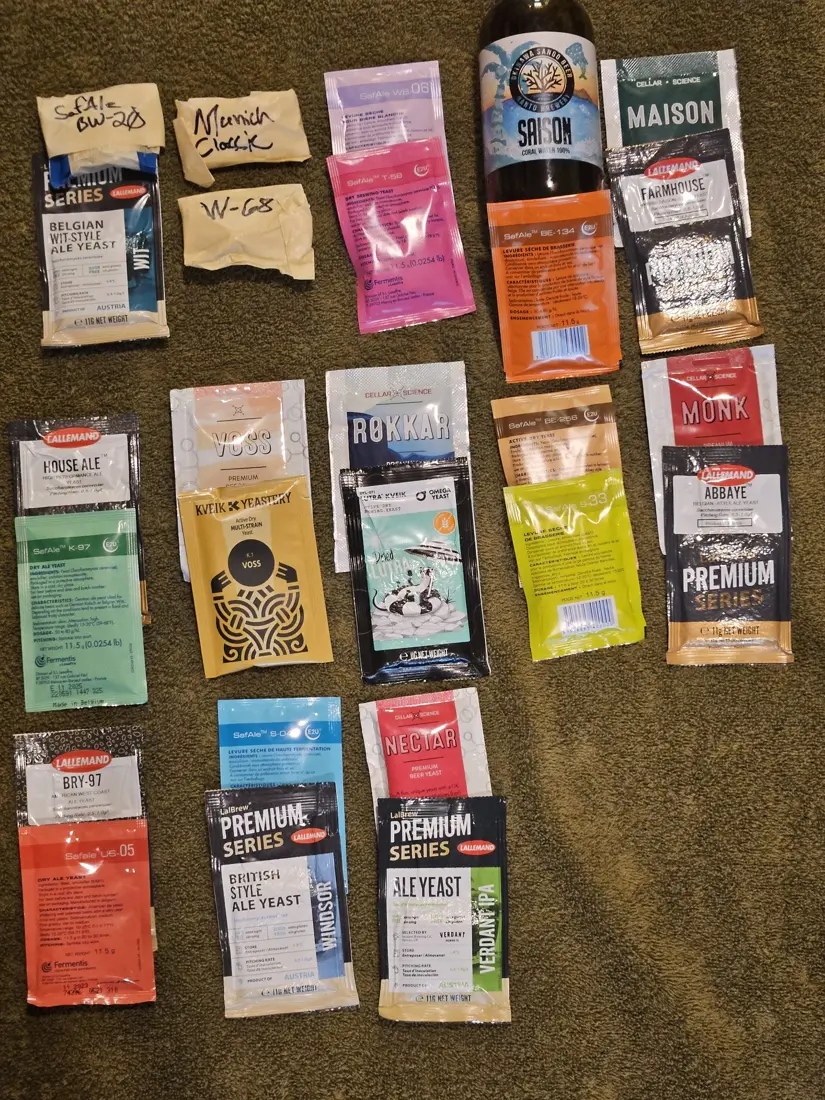
    And not just saison yeasts. I’m starting with Sunrise Saison in the wheat category, but the wider search includes Belgian ale strains, kveik (Norwegian farmhouse yeasts that ferment happily at warm temperatures), clean ale benchmarks, and English and fruity wild cards. I want to find out what each can bring to the saison I’m chasing.

    This post is the map of the whole project: the rules, the categories, every pairing, and what the winner gets. Each individual trial gets its own post with the full data. This page is where the series ties together, and I’ll add each result here after its trial article is published.

    Which saison yeast is best?

    I don’t know yet — that’s what the trials are for. The Saison Yeast Trials compare 26 yeasts in 13 head-to-head pairings across 6 categories to find one go-to saison yeast. Each pairing is tasted blind first, then scored out of 100, and the grand-final winner takes the title. Until the trials run, “best” is a guess — this series is how I stop guessing.

    The trials at a glance

    The recipesSunrise Saison for the initial Wheat & Phenolic pairings; a new purpose-built recipe for each category final (Yuzu Saison for Wheat & Phenolic). One common recipe for the grand final.
    The field26 yeasts, 13 pairings, 6 categories
    The formatInitial trials: one batch split in two, with conditions matched as closely as practical
    The scoring100 points; blind and unscored first, then scored with identities known
    The stakesLose your pairing and you’re out of the experiment
    The prizeThe overall winner becomes my go-to saison yeast
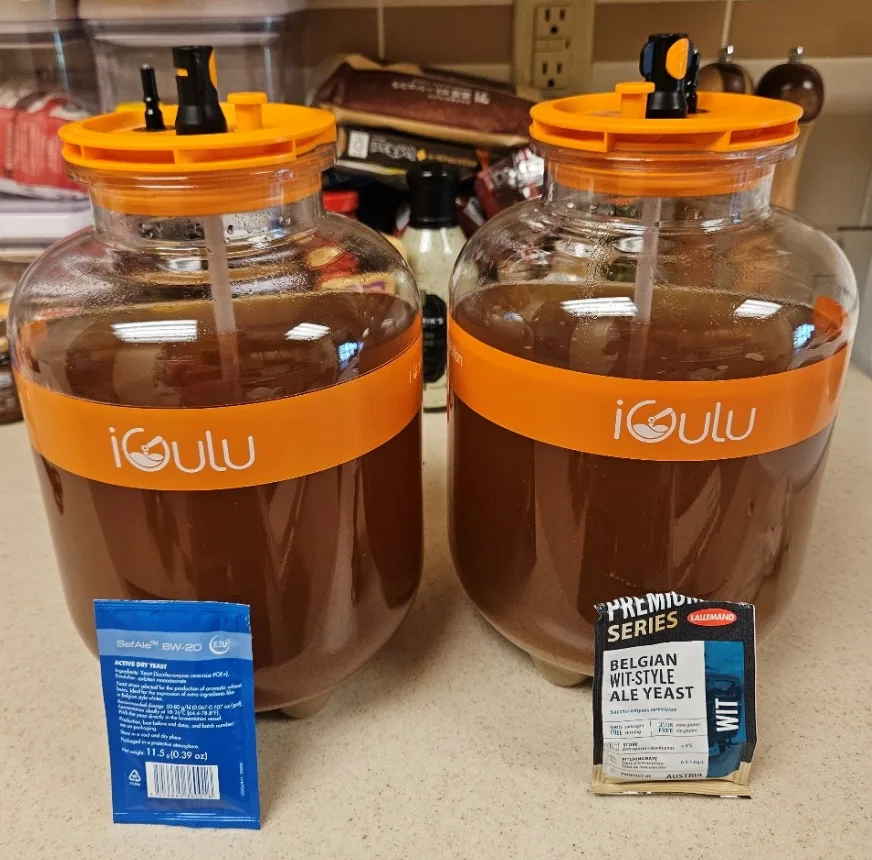
    Two iGulu S1 fermenters side by side, each holding half of a split batch of Sunrise Saison.
    The trial fermenters: two iGulu S1s, one for each yeast in a pairing.

    The beer I’m chasing

    Sunrise Saison is the recipe for the Wheat & Phenolic category’s initial pairings: a pilsner and two-row base with white wheat, a little Munich and amber malt, flaked oats, and dextrose (a simple sugar that ferments out fully) to keep it dry, with orange peel and coriander at flameout (just after the heat is turned off). What I want out of it is an island version of a saison — definite citrus, more tropical fruit, and that phenolic yeast character — the peppery, spicy notes certain yeasts produce — over the top.

    That direction guides the series, while recipe fit is judged against the recipe and flavor target for the current round. Each category keeps one recipe across its initial pairings, then uses a new, purpose-built recipe for its final. Every yeast in a direct comparison gets the same recipe. A yeast can make a good beer and still lose here because it isn’t my preferred fit for that particular beer.

    How does a trial work?

    Within each pairing, I match the conditions as closely as I can. The yeast is the variable I deliberately change, and I record any differences or interruptions — including which fermenter each yeast goes into:

    • One wort, split. Each initial trial is a single small stovetop batch of wort (the sweet liquid that becomes beer once the yeast ferments it) — about 8 L (2.1 US gal) of the recipe for that category — split into two fermenters, iGulu S1s (countertop machines that brew, ferment, chill, and dispense a gallon (3.8 L) at a time) for most trials, at about 4 L (1.06 US gal) each. Sunrise Saison is used for the three wheat-category pairings.
    • Same weighed dry dose. For the dry-yeast pairings, the planned dose is 2.75 g (1/4 of a packet) per half, weighed and pitched (added to the wort) directly. Same weight doesn’t mean the same number of live cells, but it’s the fairest simple rule I’ve got. The exception is the culture I grew from bottles of Sango Saison, which is prepared separately and pitched as a liquid slurry (yeast mixed into liquid) measured by volume — I can’t know its true cell count, so I estimate from the volume and err on the high side rather than underpitch it, and the volume gets recorded in that trial’s post.
    • Same temperature — within the pairing. I set both fermenters to the same temperature profile. That profile is chosen for the pairing, so temperatures vary across the series: the wheat pairings run cooler than the kveik pairings. This tests the yeasts under shared conditions, rather than finding the ideal temperature for each strain. Pressure settings and any interventions will be recorded in the individual trial posts.
    • Blind first, scored second. I taste the two beers blind and unscored first. At a later session, I taste again knowing which is which and score both. I do the regular tastings myself; a friend joins only to break a tie.
    • One winner. The higher score advances. If my totals tie, a friend tastes the beers blind and picks which they prefer for that round’s recipe and flavor target. I record their choice separately and keep my scores unchanged. A loss only means that yeast didn’t advance in this comparison.
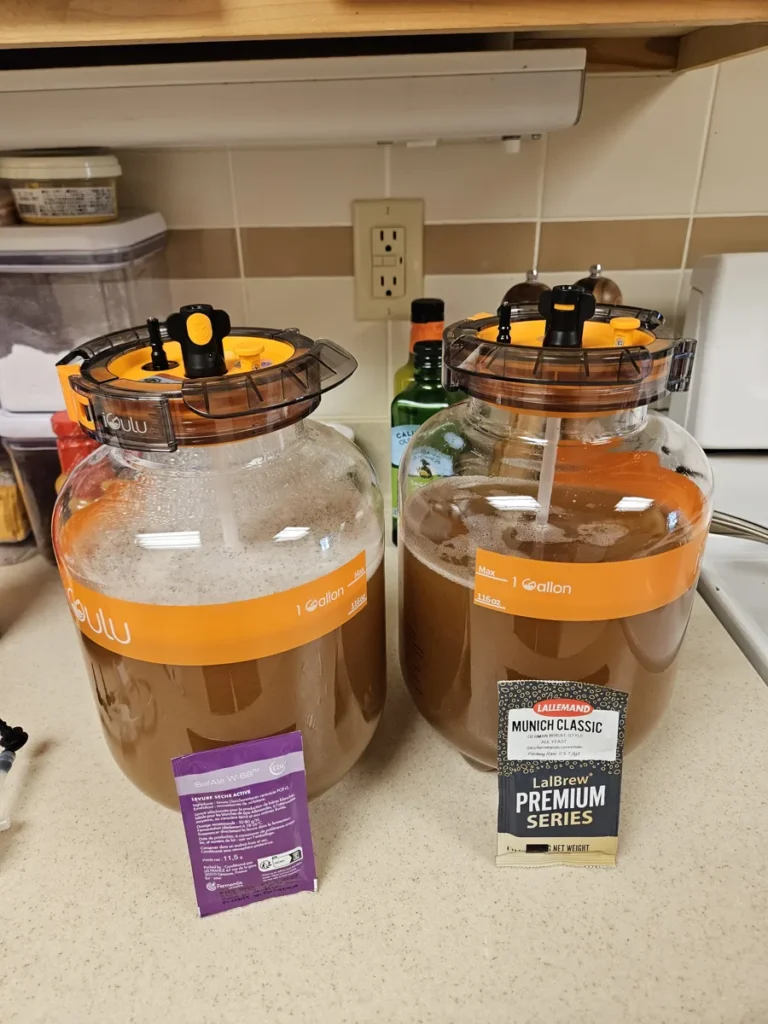
    Two iGulu fermenters of split Sunrise Saison wort with SafAle W-68 and LalBrew Munich Classic yeast packets.
    One wort, split — the same Sunrise Saison goes into both fermenters (the iGulus’ removable fermenter tanks), so only the yeast differs.

    The 100-point rubric (the weights stay the same throughout the series):

    Each beer is scored out of 100: flavor 30, recipe fit 25, aroma 20, mouthfeel and finish 15, overall impression 10.

    CategoryPointsWhat it rewards
    Aroma20Pepper and spice, citrus and fruit, and clean fermentation
    Flavor30Dryness, peppery saison character, pleasant fruit, and balance
    Mouthfeel & finish15Lively, crisp, refreshing, with a pleasant lingering spice or citrus
    Recipe fit25Does this yeast suit the recipe and flavor target for this round — does the finished beer feel balanced, and like it belongs in this recipe?
    Overall impression10Enjoyment. Do I want another glass?

    Recipe fit often decides a close pairing. Aroma and flavor tell me how a yeast performed; recipe fit tells me whether it belongs in this beer.

    The six categories

    The trials are numbered in the order they’re brewed, continuously across the whole series. Before each category starts, I post the pairings I’ve selected on Instagram, and the audience votes on which pairing goes first — so beyond Wheat & Phenolic, the pairings below don’t have trial numbers yet. They earn their numbers when they’re brewed.

    Temperature profiles below are the plan for each pairing, in °C with °F alongside. The final column tracks publication; I’ll add a link and result after each trial article goes live.

    Category 1: Wheat & Phenolic (Trials #1–3)

    TrialPairingFermentation profileTrial article
    #1SafAle BW-20 vs LalBrew Wit BelgianStart 20 °C (68 °F), ramp to 22–23 °C (72–73 °F), holdBW-20 wins 55-52
    #2SafAle W-68 vs LalBrew Munich ClassicHold 20–21 °C (68–70 °F)Not yet published
    #3SafAle WB-06 vs SafAle T-58Start 20 °C (68 °F), ramp to 24 °C (75 °F) over 2 days, holdNot yet published

    These three pairings make up the first category. I selected the matchups, and Instagram voters chose BW-20 versus Wit to go first. The orange peel and coriander in Sunrise Saison also made me curious about how these strains would handle its citrus-and-spice character.

    Category 2: Saison & Farmhouse

    PairingFermentation profileTrial article
    SafAle BE-134 vs Sango Saison cultureStart 20 °C (68 °F) for 24 hours, ramp to 25–26 °C (77–79 °F) over 2–3 days, holdNot yet published
    LalBrew Farmhouse vs CellarScience MaisonStart 21–22 °C (70–72 °F), ramp to 25 °C (77 °F) over 2 days, holdNot yet published

    This is the home category — saison and farmhouse yeasts. It also holds the series’ wild card: the Sango Saison culture, which I grew from bottles of Sango Saison, brewed by Nanto in Okinawa, Japan. BE-134 against that bottle-derived culture is the comparison I most want to see in this whole project. The trial will show how my culture performs. That doesn’t prove it’s Nanto’s house strain — it’s just what grew from the bottle.

    Category 3: Belgian Ale

    PairingFermentation profileTrial article
    CellarScience Monk vs LalBrew AbbayeStart 19–20 °C (66–68 °F), ramp to 23 °C (73 °F), holdNot yet published
    SafAle BE-256 vs SafAle S-33Start 20 °C (68 °F), ramp to 22–23 °C (72–73 °F), holdNot yet published

    I’m comparing how these Belgian-oriented strains handle fruit character, dryness, and body. The question is how those differences work in the recipe chosen for this category.

    Category 4: Kveik

    PairingFermentation profileTrial article
    CellarScience RØKKA vs Omega Lutra KveikHold 28–32 °C (82–90 °F), heat-wrap control with insulationNot yet published
    CellarScience Voss vs Kveik Yeastery K.1 VossHold 28–32 °C (82–90 °F), heat-wrap control with insulationNot yet published

    I want to see what kveik does when it’s warm. One compares two strains selected for a cleaner profile, to see how they support the recipe’s malt, hops, and other ingredients. The other puts two Voss-derived cultures head to head, with citrus and orange-like fruit among the characters I’ll be looking for.

    Category 5: Clean Ale Controls

    PairingFermentation profileTrial article
    SafAle K-97 vs LalBrew House AleHold 18–20 °C (64–68 °F)Not yet published
    SafAle US-05 vs LalBrew BRY-97Hold 18–20 °C (64–68 °F)Not yet published

    These clean ale yeasts are benchmarks for a more restrained fermentation profile. I’m interested in how the category’s recipe tastes when the yeast contributes less aroma, and whether I enjoy that balance. They’re benchmarks, not a true control — they aren’t brewed next to every other trial, so their scores can’t isolate yeast effects across different recipes or brew days.

    Category 6: English & Fruity Wildcards

    PairingFermentation profileTrial article
    SafAle S-04 vs LalBrew WindsorHold 18–20 °C (64–68 °F), optionally rising to 20–21 °C (68–70 °F) for more fruitNot yet published
    CellarScience Nectar vs LalBrew Verdant IPAStart 19–20 °C (66–68 °F), rise to 21–22 °C (70–72 °F)Not yet published

    Here I’m putting English strains known for esters (the fruity aromas the yeast itself produces) and body alongside fruity ale yeasts used for hazy IPA. I’m curious whether those characters can take a beer in the fruity, farmhouse-adjacent direction I enjoy.

    What happens after the pairings?

    Winning a pairing isn’t the end — it just earns a yeast the next round.

    The category finals. After the initial pairings, I’ll use what I learned from tasting the winners to build a new recipe for that category’s final. All pairing winners will then compete on that same recipe, with one batch split among them. For Wheat & Phenolic, that means the three winners move from Sunrise Saison to a purpose-built Yuzu Saison. The winner of that comparison becomes the category champion.

    The grand final. Each category winner gets brewed as a full 19 L (5 US gal) batch using one common recipe for all finalists. Those beers get served blind to people I know and scored by more palates than just mine — after a series based mainly on my own tastings, the final decision gets a panel. The final recipe and the rest of the tasting details will be set before that round. The winner becomes my go-to saison yeast: the strain the definitive version of my saison gets built around.

    The honest limits

    This is one brewer, one small batch per pairing, and one palate for almost every score in the series — a win here is my preference, not a lab result. With one batch per pairing there’s no way to measure batch-to-batch noise, so a win by a few points is a close call, not a measured difference. A yeast that loses here might be perfect in another recipe. The scored tastings aren’t blind, so knowing the identities may influence my judgment. I match conditions within each pairing and record what actually happened. And because recipes and temperature profiles vary across categories, rounds, and pairings, scores from separate trials aren’t a controlled ranking of all 26 yeasts. The grand final also uses separate brews of a common recipe, so batch-to-batch variation is in there too.

    Follow along

    The first trial post will cover SafAle BW-20 versus LalBrew Wit Belgian. Each trial article will tell the brew-day story, share the tasting notes and scores, and explain which yeast advances.

    The pairings for each category get posted on Instagram @alechemylab before brewing. Suggestions for future pairings are welcome in the comments — the roster above is yeast I already own, but a later round built from reader suggestions isn’t off the table.

    So, opening question for the whole series: of the 26 yeasts on this list, which one would you bet on to win it all?

    New to the Lab? Start with the Welcome post — and every trial post as it lands will be linked from the tables above.

  • Welcome to Alechemy Lab

    Welcome to Alechemy Lab

    From a Christmas Mr. Beer kit to 26 yeasts, head-to-head.

    It started with a Christmas gift and a little brown fermenter.

    Alechemy Lab is my homebrewing blog — recipes, experiments, brew days, and the questions behind them — written by a homebrewer currently brewing in Asia. The biggest project here is the Saison Yeast Trials: saison is a dry, peppery Belgian-style ale, and I’m running 26 yeasts head-to-head on one recipe to find my go-to. Start there.

    If you’ve never brewed, you’re welcome here too — I explain things as they come up.

    From a Christmas kit to all-grain

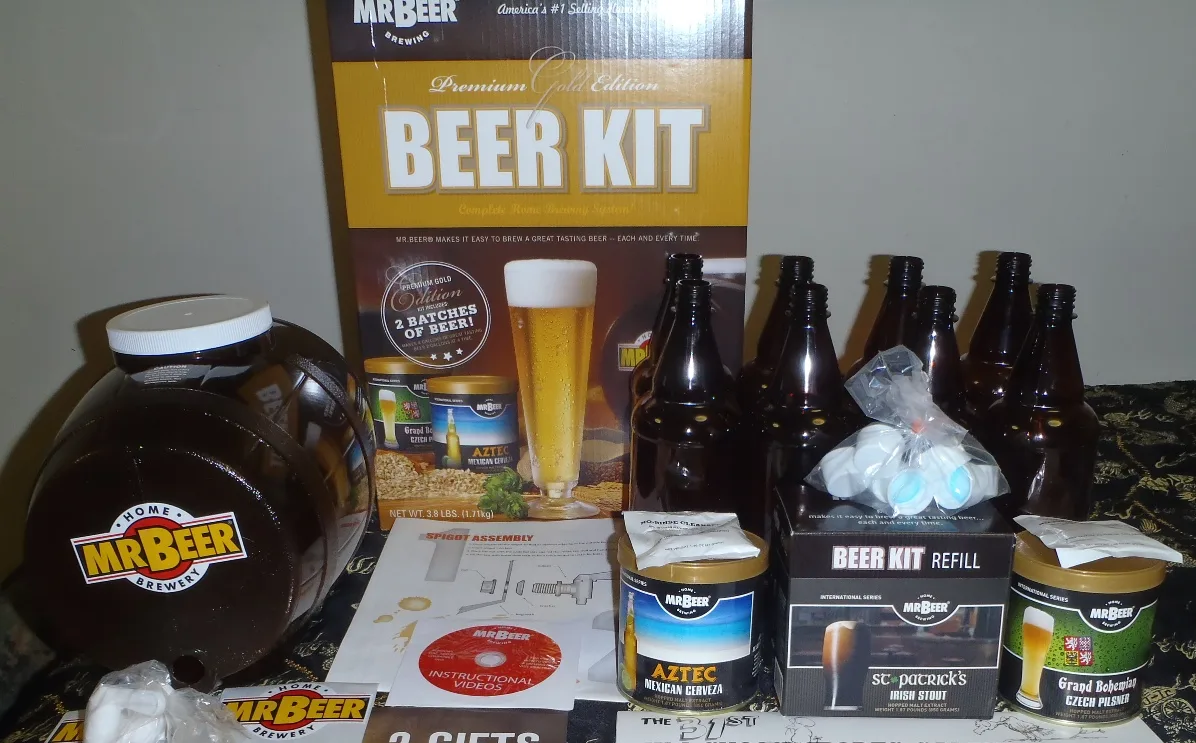
    I brewed my first beer in 2012 with a Mr. Beer kit I got for Christmas. It came with a Czech Pilsner and a Mexican Cerveza, and I was gifted an Irish stout kit too.

    Small batches, canned hopped malt extract — a ready-made malt syrup with the hops already in it, which is what the kits are built on — and a simple setup. I brewed the first one and was hooked immediately.

    By my second batch, I’d already figured out I needed to control fermentation temperatures — yeast makes harsh flavors when it ferments too warm. I put the little brown fermenter in a cooler and started swapping frozen water bottles in and out. Temperature control on batch two.

    By batch three, the Irish stout, I was toasting flaked oats and steeping them — soaking them in hot water — before mixing in the extract.

    Already off the script.

    I spent about a year in the barracks brewing more Mr. Beer kits. Then I moved into a house and switched to extract brewing with steeping grains — still working from malt extract, but steeping specialty grains in hot water first for color and flavor. About a year later, I was brewing all-grain — making the wort from crushed grain instead of extract — with a pair of coolers and a stainless-steel kettle over a propane burner.

    Two years from a Christmas kit to all-grain. That’s what this hobby does to you.

    You don’t have to move that fast, and you don’t need the gear. You don’t have to move in this order, or this slowly, either. Go at your own pace. The kit beer was worth drinking all on its own.

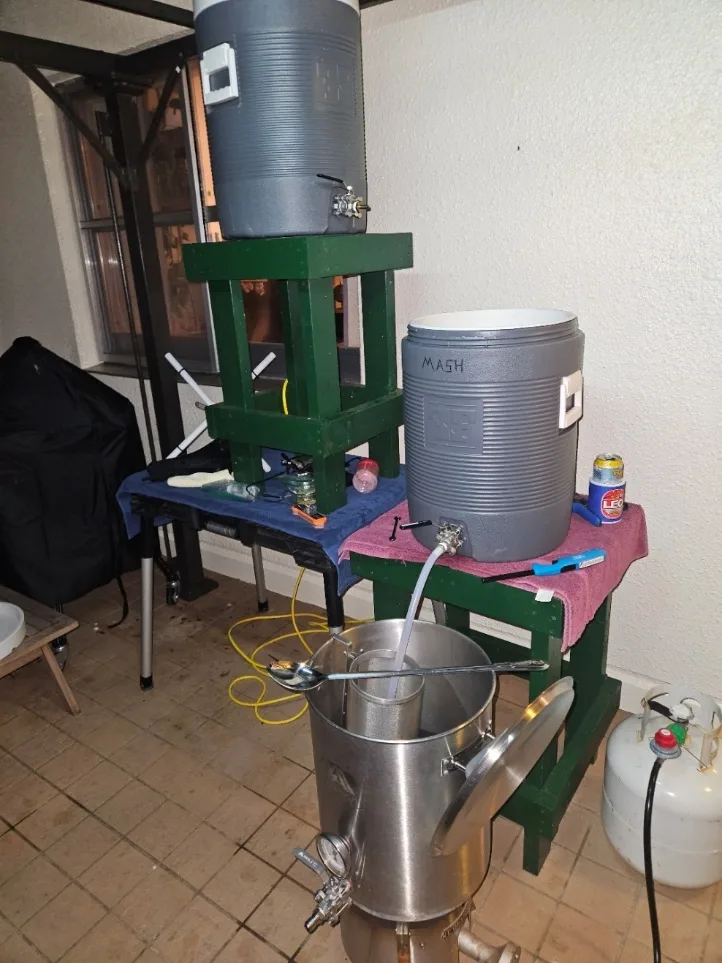
    A three-tier all-grain homebrew setup with a cooler hot liquor tank, a cooler mash tun, and a stainless steel kettle on a propane burner.
    An earlier all-grain setup, built around coolers and a stainless-steel kettle.

    Why “Alechemy Lab”

    Ale, obviously, plus alchemy. Water, grain, hops, and yeast go in; beer comes out. That transformation is a big part of what keeps brewing interesting to me.

    And Lab, because I can’t leave a recipe alone.

    What happens if I use a different yeast? Change the fermentation temperature? Keep the recipe but adjust the process?

    I want to know what actually changes in the glass. The Lab is where I work through those questions and keep the notes. I started this blog in 2026 to keep all of it in one place.

    What’s brewing: the Saison Yeast Trials

    One ongoing project is the Saison Yeast Trials. The Saison Yeast Trials compare 26 yeasts in 13 head-to-head pairings across 6 categories to find one go-to saison yeast. The trials start with my Sunrise Saison recipe: I change the yeast, taste what it does to the beer, and decide which version I’d most want to brew again. Pairing winners advance to category finals on a different wort, and the category winners meet in a grand final — full 5-gallon (19 L) batches, scored blind by a panel.

    For the initial pairings, I split one wort — the liquid that becomes beer — between two fermenters, pitch (add) a different yeast in each, and hold both to the same temperature profile. Only the yeast changes. Then I record what happened and taste the beers side by side — blind first, then scored on a 100-point rubric.

    Each post gets the recipe, the fermentation notes, and the tasting results — plus what I preferred, and why.

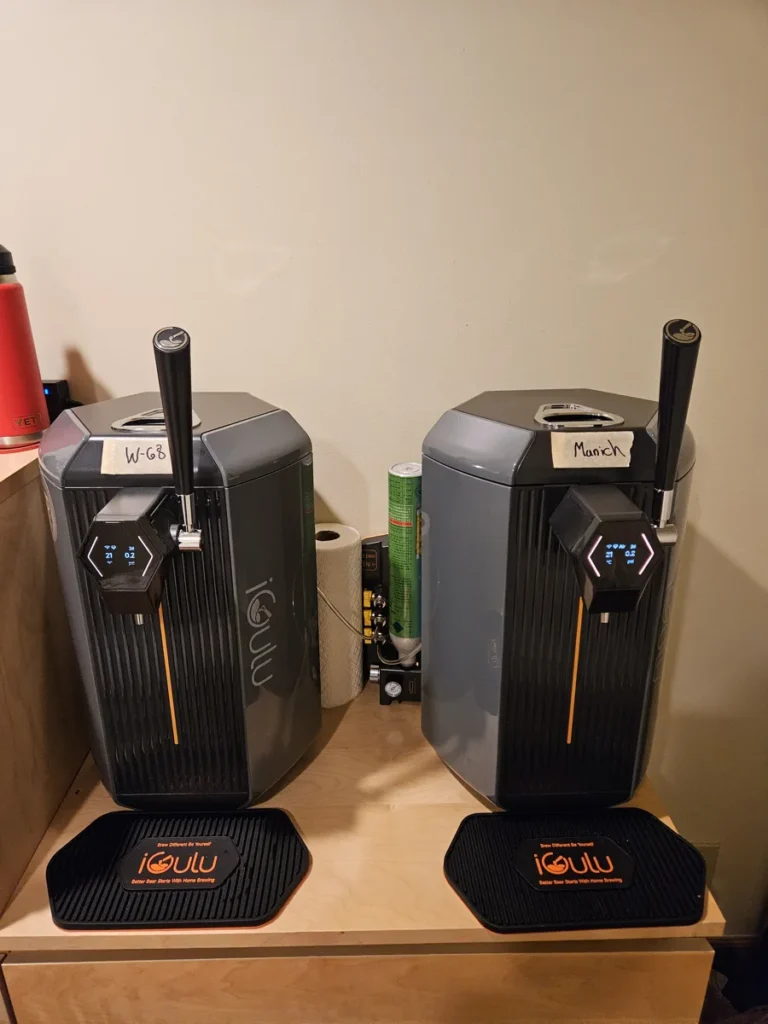
    My main system is the Anvil Foundry 10.5, an electric all-in-one brewing system with a 10.5-gallon (40 L) capacity — it mashes (steeps the crushed grain in hot water to make the wort) and boils in a single vessel. I ferment in a mini fridge fitted with a temperature controller — the grown-up version of the cooler and frozen water bottles. I also keep a small-batch stovetop setup and two iGulu S1s for small experiments — countertop machines I use to ferment, chill, and dispense batches of about a gallon (3.8 L) at a time. The yeast trials’ initial pairings run in those.

    Two iGulu S1 fermenters of Sunrise Saison side by side with SafAle BW-20 and LalBrew Wit Belgian yeast packets.
    Saison Yeast Trial #1: the same Sunrise Saison in two iGulu fermenters — SafAle BW-20 vs LalBrew Wit Belgian.

    What you’ll find here: recipes, brew days and a How to Brew series

    Instagram is where I post the day-to-day from the Lab. This blog gives me room to work through the details: why I chose a recipe, what happened on brew day, what changed during fermentation, and how the beer tasted.

    New to brewing? The basics get explained as they come up — including the unglamorous things that matter once you’ve mixed the ingredients and put the fermenter away. I’m also writing a How to Brew series — the walkthrough I wish I’d had in 2012.

    Been brewing a while? You get the yeast comparisons, the process experiments, and the equipment notes. Recipes come with the reasoning behind them and notes on what I’d change next time. For an example, start with Gilded Roast, my coffee blonde ale — brewed in September 2026, with whole coffee beans added to the keg.

    I’ll share what worked, what didn’t, and where I’m still unsure.

    Beer travels, too

    I travel often, and exploring beer is part of that. Alongside the brewing posts, I’ll share brewery visits, beer discoveries, and tasting notes from the places I go.

    Those posts are about the beer, the people making it, and where I drank it.

    If you’re looking for a first project to follow, start with the Saison Yeast Trials. Each trial post has the method, the data, and what I tasted. I’m running them to work out what I want from the next batch. Welcome to the Lab. Next: the Saison Yeast Trials — how the experiment works, and where it’s headed.